Welcome to the Crypt!

Welcome to the Crypt!

Enter the Crypt as John "The Unimonster" Stevenson and his merry band of ghouls rants and raves about the current state of Horror, as well as reviews Movies, Books, DVD's and more, both old and new.

From the Desk of the Unimonster...

From the Desk of the Unimonster...

Welcome everyone to the Unimonster’s Crypt! Well, the winter’s chill has settled into the Crypt, and your friendly Unimonster won’t stop shivering until May! To take my mind off the cold, we’re going to take a trip into the future … the future of Star Trek! Star Trek was the Unimonster’s first love, and we’ll examine that in this week’s essay. We’ll also inaugurate a new continuing column for The Unimonster’s Crypt, one written by the Uni-Nephew himself! This week he examines one of his favorite films, one that, quite frankly, failed to impress his uncle, Jordan Peele’s Nope. So enjoy the reading and let us hear from you, live long and prosper, and … STAY SCARY!

Popular Posts

Followers

Essays from the Crypt

Essays from the Crypt
Buy the best of the Unimonster's Crypt

Search This Blog

02 January, 2011

DVD Review: The Complete METROPOLIS

Title:  The Complete METROPOLIS

Year of Release—Film:  1927 (Restored version 2010)

Year of Release—DVD:  2010

DVD Label:  Kino International


One of the most influential films ever produced, Fritz Lang’s 1927 masterpiece METROPOLIS has long been hailed by critics as the seminal film in the Science-Fiction genre; the film that, more than any other, is responsible for shaping what modern Sci-Fi fans see on the screen.  No less a fan than Forrest Ackerman, the man who coined the phrase, “Sci-Fi,” considered it his favorite movie, one he had seen dozens of times.
Scripted by Thea von Harbou (at the time Lang’s wife), METROPOLIS is the tale of a great, futuristic city, divided between those of privilege, who live in the towering skyscrapers, and those who dwell underground, running the machinery that powers the great metropolis.  Freder (Gustav Fröhlich), the son of the founder of Metropolis, Joh Fredersen (Alfred Abel), lives an idyllic life.  His days are spent in pursuit of pleasure, in recreations such as sports, and pursuing liaisons with women eager to please the son of the city’s manager.
While he and several other sons of the elite are indulging themselves in playfully chasing these willing women through a garden, a door opens and a beautiful woman, poorly dressed, enters, leading scores of dirty, disheveled children in with her.  She points out the children of privilege to her charges, introducing them as their “… brothers.”  Attendants rush to remove the intruders, but Freder is captivated by the woman, and he follows her back into the bowels of the city.  There he discovers the truth behind the life of luxury enjoyed by the elite is the unceasing, backbreaking labor of those who live below.

Freder witnesses an industrial accident that leaves dozens of workmen dead.  Emotionally distraught, Freder imagines the great machine to be an enormous demon, consuming those who labor on it.  He staggers from the scene, finding his way back to familiar surroundings.  Still overwrought from his experience he goes to his father’s office, informing him of the tragedy.  In contrast to his son’s emotionalism, however, Joh Fredersen is annoyed that it fell to his son to bring him this news, rather than his secretary, a man named Josaphat (Theodor Loos).  Fredersen is further angered when Grot, the foreman of the workers, brings him cryptic diagrams found on the bodies of the dead workers, which would seem to indicate some sort of subversive activity.
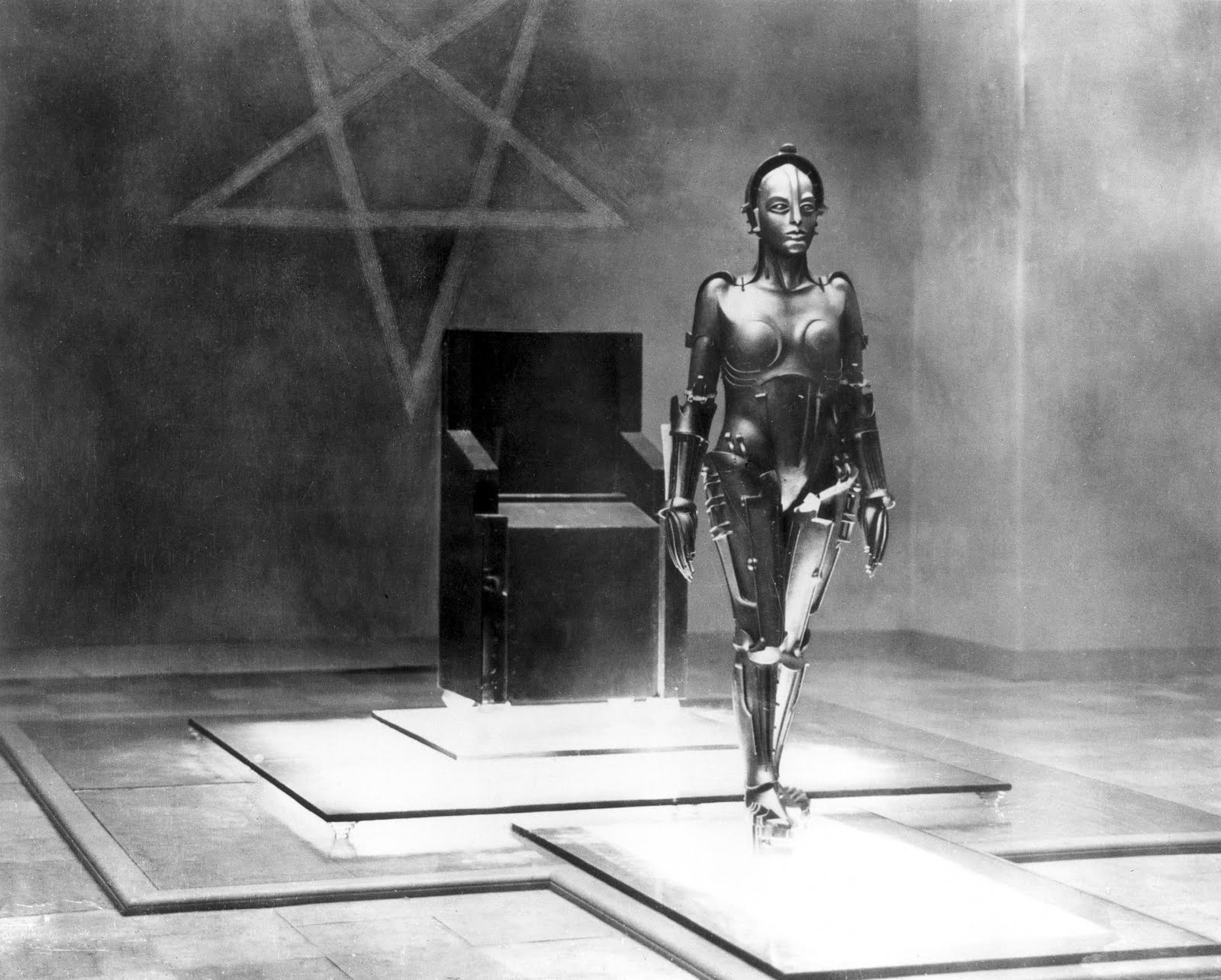
When his experts prove unable to explain the meaning of the papers, Fredersen seeks the counsel of the one man who he feels can provide the answer—the scientist Rotwang (Rudolf Klein-Rogge).  As young men, they had been close friends; however, that ended when Hel, the woman Rotwang loved, left him for the wealthy and powerful Fredersen.  She died giving birth to Joh Fredersen’s child, and Rotwang has hated Joh ever since.  He has constructed a “Machine-Man” (though in the shape of a woman) which he reveals to Fredersen, explaining that he intends to give it the appearance of his long-lost Hel.
The inventor recognizes the diagrams; they are in actuality maps of ancient catacombs that lie buried far beneath the city.  The pair journeys down into the underground passages, and find a large gathering of workers.  A young woman is addressing the gathering, recounting the biblical story of the Tower of Babel.  It is Maria, the same woman who so captivated Freder in the garden.  In her interpretation of the story, the moral is that between those who planned the great tower (the Head), and those who were tasked with building it (the Hands), there was no communication, no sense of common purpose.  They needed a “Mediator” between them, the Heart, which must join Head to Hands.
As Fredersen ponders the woman’s message, he fails to notice that, among the crowd of workers, is his own son.  He has traded places with a laborer in order to experience that life, while the workman, Georgy #11811, is enjoying himself with the diversions of wealth.  Rotwang however, recognizes his rival’s heir speaking with Maria after the ‘lesson’, but keeps that information to himself.
Fredersen asks the scientist to give the maschinenmensch (machine man) Maria’s image, in order to spread dissension between the workers and she.  Rotwang agrees to this plan, concealing his true intentions—to destroy the man who robbed him of his love.

Filmed over a period of eighteen months, from March 1925 to October 1926, METROPOLIS was the costliest silent production ever undertaken, at RM (Reichsmarks) 5,000,000 (nearly $15 million, in 2009 dollars).  Photographed by Karl Freund, Günther Rittau, and Walter Ruttman, with special effects by Eugen Schüfftan, it was also the most technically ambitious film of its era.  Produced by UFA, the leading German studio in the 1920’s, Lang’s masterpiece drove the company to the brink of bankruptcy.  It premiered in Berlin on 10 January 1927, at a running time of 153 minutes.

However, shortly after its Berlin premiere, the film was heavily edited, primarily at the behest of Paramount, the studio that would distribute the film in the United States, in order to make it more commercially marketable, as well as to eliminate certain scenes that would cause problems for American exhibitors.  Much of this editing was done by Channing Pollock, a noted American playwright.  The effect of these edits shortened the film considerably, as well as altered the storyline, eliminating some plot elements entirely.  The movie became less concerned with the class struggle between those who lived in the gleaming towers of the magnificent aboveground city and those workers who tended the machinery below.  The emphasis of the story shifted to the film’s Science-Fiction aspects.  The German negative was then edited to conform to the US cut, and the sections of film excised were destroyed.  For more than eighty years, the original version of METROPOLIS was lost.

However, in 2008 it was announced that a complete negative, including that material removed in the Pollock edit, had been found in a film archive in Buenos Aires, Argentina.  The original had been transferred to 16mm at some point, without the original negative having been cleaned and properly restored first.  The result was a negative cluttered by dust, scratches, and artifacts that are now part of the image.  Nonetheless, it was a complete negative, and using it, a restoration team headed by Martin Koerber was able to recreate the movie almost as it was at the January 1927 Berlin premiere.  In February 2010, the restored version had its premiere in Berlin, just over 83 years after it had first screened.  That version is now available from Kino International in a deluxe, two-disc DVD, The Complete METROPOLIS.

Priced at $20.97 direct from Kino ($18.99 from Amazon.com), this disc is comfortably within what I consider a reasonable price range, particularly for so important a film.  It adds roughly 25 minutes to the 119-minute runtime of the 2002 restoration, as well as filling in the plot holes which have existed since 1927.  Characters once thought to be at the most minor roles have been expanded into important figures in the story.  The effect is, if not a different film, then certainly one that must be viewed in a different light.

Included on the DVD’s second disc is a documentary on the history of the movie and it’s many changes through the years, Voyage to Metropolis.  This includes footage of interviews with Lang prior to his death, as well as with those who were instrumental in bringing this version to light.  The documentary is invaluable for fans of the movie.

It’s always tricky recommending that readers buy a silent film—not because of any flaws in the films themselves, but because modern viewers seem to have little patience for silents.  If you are someone who has this ingrained dislike for silent film, please try to overcome it here.  This is arguably the most historically significant Science-Fiction motion picture ever.  It deserves to be seen and appreciated, and the fact that it can now be seen as intended only reinforces that recommendation.

Junkyardfilm.com's Moldy Oldie Movie of the Month: LEGEND OF BLOOD MOUNTAIN

Title:  LEGEND OF BLOOD MOUNTAIN

Year of Release—Film:  1965


Bestoink (pronounced Bes-toy-ink) Dooley, a copy boy for a newspaper for 16 years, hears on TV that Blood Mountain is bleeding again and people are being killed.  Pleading with his editor to let him try his hand at reporting, he finally gets permission to investigate the phenomenon.  Driving up to Blood Mountain, he interviews a few locals and learns that a scientist and his daughter are encamped on the mountain.  Bestoink decides to join the scientist and his daughter and discovers, to his horror, that the substance, once thought to be rust from the iron-rich soil, is, in fact, human blood!  And, judging by the number of locals savagely attacked, the legionary Beast must be awake!  Later that evening, an aging maid tells Bestoink her mother once saw the Beast and it caused her premature death eight years after the sighting.  Despite this grim warning, the daughter leaves to attend a beach party.  Bestoink is pressed into service to drive the daughter's friend back into town.

While driving along in Bestoink's classy sports car, the couple comes across the beach party attendees and stops to warn them that another deadly attack has occurred.  This warning serves to take the hats-n-horns out of the festivities and the party breaks up.  Continuing on their journey, Bestoink is startled to see the Beast in the road!  Swerving, he crashes the car into a tree, knocking himself unconscious.  Menaced by the monster, the girl flees, terrified, into the woods.  Bestoink is discovered by the scientist and his daughter and, roused from his unintended slumber, Bestoink tells them of this terrible turn of events and, dropping the daughter at a nearby ranger's station, Bestoink and the scientist leave to search for the missing woman.  Will Bestoink find her in time to save her life?  Will Bestoink get his story?  Will the bumbling Bestoink finally be the hero he so longs to become?

LEGEND OF BLOOD MOUNTAIN defines zero-budget filmmaking.  So, imagine my surprise when I found out it's filming budget was $750,000!  And, I was rendered speechless when I read it grossed $1,250,000 at 450 'hardtop' theaters opening weekend!  This phenomenon couldn't be due to the acting, which was abysmal, or the directing which was lackluster or the plot that meandered from horror to comedy and back again at a moment’s notice!  That is was filmed using reel ends is obvious by it's ever-shifting color and clarity.  Certainly the 'special effects' weren't the cause of it's large filming budget.  The Beast was a man in a pale gray body suit with hairy leggings, two tails and what looked to be Stay-Puft marshmallows glued to his chest and face.  Maybe it was the cookie budget...used in the scene where the chubby and balding Bestoink sits in bed, eating cookies for four minutes!  Whatever the reason, this movie sucked!

But, enough about the movie!  Let's look at the man behind this craptastic film!  Bestoink Dooley aka George Ellis was a well-known and apparently much-loved Atlanta-area TV horror host of the Friday Night Big Movie Shocker (1950-60's).  Fans remember fondly that he treated the old Universal movies with the respect they deserved...never cutting the movie or interrupting it, saving his hijinks for the beginning and end of the movie and for commercial breaks.  He also was the host of a half-hour TV program for children called Dooley & Co., which showed mostly Three Stooges short films with Morgus the Magnificent doing fake weather reports and news items between the shorts.  His primary target audience seems to have been young children and tweens.  He made many personal appearances at theaters and schools, where children, frightened by this horror host in a bowler hat and with a squirting flower in his lapel, would peek at him from behind the safety of their parents.  He was also a regular on the local live theater circuit and once played opposite Vincent Price's Fagin in the Theater under the Stars production of OLIVER, as the blustering parish beadle, Mr. Bumble.  When Ellis appeared on stage, the audience burst into wild applause!

Prior to LEGEND OF BLOOD MOUNTAIN, Ellis appeared on two TV crime shows.  After LEGEND, Ellis appeared in five movies, Among them SWAMP COUNTRY with Lyle Waggoner and HONEY BRITCHES, a sexploitation flick, all apparently regional films made for the Drive-in theater crowd.  But, the one movie Ellis is most remembered for it MOONRUNNERS.  In it, he plays Jake Rainey, a bootlegger.  James Mitchum, son of actor Robert Mitchum, played Grady Hagg.  It was written and directed by Gy Waldron, who went on to create and script The Dukes Of Hazzard TV show four years later and is believed by some to be the pilot to that TV show.  The part of Jake Rainey was later changed to Boss Hogg.

Despite this busy schedule, Ellis also had a serious side.  His Film Forum in Atlanta had been popular for years and need a larger theater location to exhibit art films.  In 1982, with partner Glenn Sirkis, he began renovation of the Euclid Theater, derelict for many years.  Their goal was to reopen it as a duplex called The Masterpiece Cinema that would show foreign-language films on one screen with the other screen dedicated to English-language films.  Sadly, George didn't live to see his greatest efforts fulfilled, dying suddenly in June 1983.  At his funeral, Glenn Sirkis announced the renovation would go on and the theater would be named the Ellis Theater.  The theater closed without notice in 1988, renovations still incomplete.  In 1989, producer Paul Blane bought it, finished the renovations, renamed it The Variety and today it's a playhouse for mostly musical acts.  It's marquee can be seen on Turner Classic Movies (TMC) station segment titled Classic Movie News.

On E-Gor's Chamber Of TV Horror Hosts, [ http://myweb.wvnet.edu/e-gor/tvhorrorhosts/hostsb.html ] his many now older fans recall George Ellis/ Bestoink Dooley fondly, saying:

"What made George Ellis such a wonderful monster movie host was that he was a lovable old ham with a great sense of humor.”  Richard Moore
 
Cynthia G. Brundage recalls "...all those thrilling late nights sitting wrapped up in a blanket in front of the old black and white and peeking through my fingers at Boris Karloff and other guys too scary to watch without digit protection!  Thank God for Bestoink Dooley!"

"Now there is a name one wouldn't soon forget.  As a kid growing up in Marietta, Georgia, during the 50's and 60's, we LIVED for Friday nights and The Big Movie Shocker with host, Bestoink Dooley.  I think a big part of my love for old sci-fi and horror movies grew from those repeated viewings.”  Bob Chapelle

So, yes...even though Bestoink Dooley starred in the "worst movie you've never seen,” he still has legions of fans who grew up with him and still remember him as a mighty influence in their lives.  And, when all is said and done, that's all that really matters.

MSTjunkie
Enjoy!  Or not.

05 December, 2010

Aurora’s Monster Models


ARTICLE TITLE:          Aurora’s Monster Models


As many devoted Horror fans also enjoy building model kits of their favorite monsters, most are well aware that Modeling is not an inexpensive hobby.  At a bare minimum, a decent resin kit from a reputable company will run 50-60 dollars, and the average would be well over $100.  Add in tools, paints, and time, and we could easily spend thousands on this hobby we love.

But that wasn’t always the case.  When I started building models, resin and vinyl kits were virtually non-existent.  Airbrushes and moto-tools were unimagined luxuries, glue came in red and white tubes and paints came in little square bottles with “Testor’s” on the cap.  My first kit was ancient even in 1972…  Monogram’s 1/72 scale Curtiss P-36 Hawk.  I doubt that I paid more than 75¢ for it, and the finished product was hardly worth bragging about.  But I was instantly hooked on a hobby that I still enjoy 37 years later.

In those days I built everything and anything… from the crappy Hawk box-scale airplanes, to Monogram TBF Avengers with a torpedo that actually dropped from the bomb bay, to Aurora’s Russian Golf-class Missile Submarine.  I even tried my hand at the Visible Eye… and wound up with something not even Lasik could save.  But given my natural affinity for the monsters, it was only a matter of time before I found the fantastic Monster kits from Aurora.

Anyone who was a regular reader of Famous Monsters in the ‘60’s and ‘70’s will remember the ads for these kits…  Dracula and Frankenstein, the Wolf-Man and the Mummy, the skeletal Prisoner chained to the section of dungeon wall, even a scraggly-toothed, wart-nosed witch, hard at work stirring a bubbling cauldron.  Famous Monsters #59, November 1969, lists several of the monster kits in the Glow-in-the-Dark style for the princely sum of $1.49… quite a bit of money when you consider that you could get a perfectly good airplane or car kit for half that.

But the monsters of Aurora were hard to ignore, and, as soon as I saw one for sale at my neighborhood Pic-n-Save, I had to have it.  It was, luckily, my favorite monster, the Mummy.  But I wouldn’t have cared which monster I wound up with…  I just wanted one of them.  Somehow, I came up with enough money to buy it.  How, I’m not sure; I am sure that it was no mean feat on a dollar a week allowance.  How much I paid for the kit is a mystery; I doubt I could have told you the next morning the price of the model.  I had one, and that was all I cared about.

When I got home with my prize, I rushed to my room and opened the box.  The figure seemed huge compared to the kits I was used to building, though simple to assemble… a definite plus at that stage in my modeling experience.  I can’t recall much detail about the kit, other than the Mummy was undeniably Kharis.  I don’t remember what color plastic it was molded in, or how good the quality was.  I just remember the joy of building it.

I later added other monsters to the collection, as well as some of the MPC Pirates of the Caribbean and AMT/Ertl Star Trek kits.  There was a Tarzan along the way, as well as a Spock, a Batman, and others.  Eventually, Aurora folded, the monster kits went away, and I returned to the B-17G’s, M60A1’s, and Federation Starships that I loved.

Now, some thirty-seven years later, those Aurora monsters are hot collector’s items, going for thirty to fifty dollars, unbuilt.  Companies such as Polar Lights have issued their own versions of those kits, and high-quality resin and vinyl monster kits abound.  These kits, especially the latter, are so far above the old Auroras in terms of quality and accuracy that comparing the two is akin to comparing a ’78 Ford Pinto to a brand-new Mercedes S-class.  I just wish I could afford them.


Yes, the new kits are better in terms of quality, better in terms of accuracy, better in terms of choice of subject matter.  The only thing they don’t do better is inspire joy and wonder in the mind of an eight-year-old boy.

Monster Toys and Ghoulish Goodies*


ARTICLE TITLE:          Monster Toys and Ghoulish Goodies*


There are certain things that tend to remain with you from childhood, things that have the power to pull you back through the intervening years… the smell of bacon frying on a chilly Autumn morning that instantly wakes you up; the whistle of the feedback that would come from my dad’s hearing aid when the earpiece wasn’t adjusted just right; the sight of a Christmas tree surrounded by kids, and heaped high with gifts.  These are just some of the touchstones of my childhood, things that remind me of who I am and where I come from.
Other anchors to my past are more idiosyncratic:  rushing home from school to watch Dark Shadows and Star Trek in the afternoon, or fighting to stay up all night, just to see if I could.  My comic books and my monster mags.  My models, and my baseball and football cards.  But few things define a kid as clearly as the toys he plays with, or those he wishes he had; and few memories of childhood are sharper.

My personal taste in toys was similar to my tastes in entertainment.  I had a G.I. Joe of course, the real one, not the 3¼-inch rip-offs of the ‘80s.  He had a fully equipped foot-locker, including an astronaut’s space-suit, a deep-sea diving suit, and various combat fatigues.  He could also boast more firepower than the 2nd Marine Division, with everything from a Colt .45, to a flame-thrower, to an M-16.  He led a veritable regiment of toy soldiers, of every conceivable size, shape, and shade of plastic.

There were dozens of toy airplanes, ranging from tiny little plastic ones intended as party favors, to one massive cast-iron Tonka plane my older sister gave me, that now would be regarded as a lawsuit waiting to happen.  It had folding wings that pinched me constantly, working landing gear that did the same, and weighed at least 2 lbs.  I’m sure that today it would be classified as a deadly weapon in most states.  Nor was the Navy neglected, as one of my favorite toys was a plastic Seaview submarine, from the TV show Voyage to the Bottom of the Sea.

But in the end, I was a child of the Ackermonster, and the toys that really stood out were the Monster and Sci-Fi toys that I owned.  Star Trek was my first love, and it was well represented in my toybox.  I had all the 8-inch Mego figures, along with the U.S.S. Enterprise Bridge playset… with working transporter, no less!  At one point or another I built every Star Trek kit AMT/Ertl put out… multiples of the U.S.S. Enterprise, as they were thoughtful enough to provide decals for every Constitution-Class starship in the fleet; the 1:1 scale Phaser, Tricorder, and Communicator set; the Klingon and Romulan ships… let’s just say a significant portion of my allowance went to that company.

The monsters certainly weren’t neglected, either.  I had toy Draculas, Frankenstein’s Monsters, Mummies… the entire Universal pantheon was well represented, as was Toho’s stable of Kaijû.  Most of these were, in retrospect, probably cheap, unlicensed knock-off’s… but that mattered not at all to a young MonsterKid who just wanted to play with his beloved monsters.  Fortunately, I was born in a time when such toys cost at most a dollar or two.  The situation isn’t so good for aspiring MonsterKids today.

As dedicated Monster collectors will attest, there is no shortage of Horror collectibles on the market today, and most of them are truly superb in terms of quality and faithfulness to their subject.  Sideshow Toys, the 800-lb. Gorilla of the Horror collectible world, leads the way in this, with dozens of beautifully sculpted figures and busts, capturing virtually all of Universal’s Monster characters, and many more modern horrors as well.  Meca and Hawthorne Village are also producing Horror collectibles; just as attractive, and just as high quality.

The one drawback to all of this?  Price.

The 12-inch Sideshow figure of Lugosi as Dracula, in the box, can cost several hundred dollars, as will the Karloff Monster, or Karloff as Im-Ho-Tep.  The complete Hawthorne Village Universal Horror town collection would represent an investment of more than a thousand dollars.  Prices for these Horror collectibles are steadily climbing, with no sign yet of softness in the market.  Yet for all their beauty and quality, they fail to fufill their prime function as toys… to be played with.

For all the Horror merchandise out there, there’s precious little that you’d let your seven- or eight-year old MonsterKid rip into in a sheer, unadulterated frenzy of childish glee.  Let’s face it, when you pay $300 for a Sideshow figure, you aren’t likely to even take it out of the box, much less hand it off to a sticky-fingered rug-monkey who ten minutes before was burying his little sister’s Malibu Barbie® in mud.  And that’s the real sadness of this.

Unless you are in your ‘80’s, you aren’t likely to have fallen in love with the classic Monsters in a movie theater.  If, like me, you’re a Baby-Boomer, then your first exposure to Karloff as the Monster, or Chaney as the Phantom, was on TV… as some middle-aged guy in monster make-up cracked bad jokes in-between segments of the movies.  Your love was fed and encouraged in the pages of Famous Monsters, and Fantastic Monsters, and Tales from the Crypt.  And it found expression in the models we built, and the 8mm monster-movies we made, and the toys with which we played.

Well, with few exceptions, infomercials have crowded out the time-slots that used to be devoted to the Horror-Hosts.  Famous Monsters is long gone, replaced by a pale, bastardized imitation.  And the models and toys of our youth have been replaced by $150 high-tech resin kits and $500 sculpted busts.
As the horror industry constantly chases their next dollar, skewing the market towards the older collectors, those who can afford to pay a few hundred dollars a pop for a collectible and have no desire to actually touch their acquisitions, perhaps they should be more concerned about where the next generation of fans will come from.

I have three Sideshow figures.  They aren’t in their boxes, and they are routinely handled.  They may not be worth $300… they may not even be worth what I paid for them.  But the joy they’ve given me has nothing to do with dollar signs or condition grades.

It’s a shame our kids can’t know that kind of joy.


*    From an idea suggested by fellow CreatureScape contributor Elizabeth Haney—with thanks, JPS

“Just an 8-bit Guy in a xBox World…”

This will be an unusual column for me, one focusing on video games instead of my more familiar venues.  I’m not a gamer; I don’t have an xBox, or a Wii, or a PS3.  I have a Playstation, period… with maybe six games.  The only one I play frequently is Tiger Woods Golf ’99.  I just don’t have the time, money, or inclination to spend hundreds of dollars on these high-tech consoles, accessories, or games.
But that doesn’t mean I don’t enjoy video games, or that I was never addicted to the electronic lure of dancing sprites.  In fact, there was a time when I spent virtually every free minute hooked to a gray and black controller, moving two-dimensional characters through side-scrolling worlds.  I was a Nintendo junkie, and Super Mario was my drug of choice.
That initial video-game craze hit at just the right time for me.  In my twenties, in my own apartment for the first time, with limited entertainment options, the Nintendo Entertainment System seemed like a cheap way to fight off boredom.  I’d get home from work, fix supper, and settle down to guide Mario on his quest to rescue Princess Toadstool from the evil clutches of Bowser.  My only weapons in this quest:  My jumping ability; my power to stomp Goombas; a few power-ups; and my mastery of kicking Koopa-Troopers and running along behind as they cleared a path for me.
Before too long, I had mastered Super Mario Bros., only to discover at the end that “…our Princess is in another Castle!”  I progressed onto Super Mario Bros. 2, only to discover that it bore no relation to the first game.  It was, in fact, a remake of a Japanese game, Doki-Doki Panic.  The game’s creators had simply replaced the original characters with ones from the Super Mario Bros. game.
While generally disliked by fans, I loved the game, and thought it was every bit as enjoyable as the first.  It gave you the option to play as any one of four characters:  Mario; his brother Luigi; the Princess’ faithful retainer Toad; and the Princess herself.  Each had their own strengths and weaknesses, and part of mastering the game was learning when to play each one.  And while it proved more difficult to complete than the first, in due course I had beaten it, as well.
However, the adventures of the two Italian plumbers weren’t the only games I conquered back in the day.  Tetris was a favorite of mine, as was 1942.  Silent Service got nearly as much playing time as the Mario’s, and even Duck Hunt had its moments.  And of course Castlevania III: Dracula’s Curse soaked up much of my free time, as I battled monsters and demons in a campaign to destroy Dracula.
Still, I always returned to the Mushroom Kingdom, and finally faced the ultimate NES game, at least as far as I was concerned…  Super Mario Bros. 3.  This wasn’t just a revamped version of the first game; this was something completely new and different.  This game had map screens, and sub-games, and it completely blew me away the first time I popped the cartridge in my player.
Sadly, I never completed SMB3.  My player, like all the Nintendo front-loaders, had a fatal flaw that rendered them virtually unusable after a comparatively short time.  I had completed maybe five levels when my player fell victim to this flaw, and I had to quit my gaming addiction cold turkey.
Like many facets of my childhood and youth, the pangs of withdrawal soon faded as adult life insisted on intervening.  Eventually, the memories of my 8-bit escapades receded into the dark caverns of my mind, where they slumbered peacefully awaiting the light of day once again.
Recently, that day dawned.  I was looking for a PS2 game for a Christmas gift, and found a video game store in my area that dealt in used and vintage games.  I was unable to find the game I was looking for, but as I was browsing, I noticed a small, odd-looking console sitting on a shelf.  The only marking on it was the word “Yobo” next to a cartridge slot in the top of the console.  Curious, I asked the clerk what system it was, and what the games were like.  He just glanced at it, and said that it was a NES-clone, and it played all the original NES games.
Instantly, a flood of nostalgia washed over me, carrying me back through the intervening years.  I could hear the insidiously viral Super Mario theme fighting its way back to the forefront of my consciousness, and my thumbs began itching for the feel of the controller again.  Unfortunately the cost of the system, though not unreasonable, was more than I could afford at the time; but I knew I had to have one once the holidays were through.  I asked the twenty-something clerk if it was an item they kept in stock; would they still have one in a month or so?  He just looked at me as though I asked in which aisle would I find spats and buggy whips.  “Who wants to play old Nintendo games?” was his only response.
Well, quite frankly, I do.  And I fully intended to head back after the holidays to buy the console, and the Super Mario game of days gone by, but something intervened to make that trip unnecessary.
A good friend of mine asked me what I wanted for Christmas.  Giving it some thought, I said “a Nintendo.”  After I explained that I wasn’t talking about the Wii that costs several hundred dollars, she said that sounded like a good present, and promptly changed the subject.
Now, in the time that I’ve known this woman, and we’ve been exchanging gifts, not once has she given me what I had told her I’d like when asked “What do you want for…  [Insert Holiday of choice]?”  Don’t misunderstand me… her gifts are always nice, usually nicer than what I had wanted.  I’ve just learned that, no matter my response to her question, I will be surprised when I open my present.  This year was no exception.  In fact, this year was the biggest surprise of all.  This year, I got exactly what I asked for.
So now I sit in front of the TV, the Super Mario Bros. start screen displayed in all its glory, awaiting the command to once more launch Mario on his quest.  It feels as though I just returned to a game I had pressed the pause button on… over 18 years ago.  For four years of my life, I played this game at least two or three hours a day—every day.  The feel of the controller, like the movements needed to make the little plumber do battle at my command, are ingrained into my muscle memory by those thousands of hours of gameplay. 
Other games will follow, and ultimately I will be able to finish my struggle with the King Koopa and his children the Koopalings from SMB3.  But right now, this is good… this is enough.  There’s an expression I’ve heard that I feel describes me pretty well.  I’m not sure where it originated, if it’s something from TV or something I picked up like lint on Velcro.  “I’m just an 8-bit guy in an xBox world…”  And I couldn’t be happier about it.

The Unimonster's Crypt Screening Room: HARRY POTTER AND THE DEATHLY HALLOWS, Pt. I


Title:  HARRY POTTER AND THE DEATHLY HALLOWS, Part I

Date of Theatrical Release:  19 November 2010

MPAA Rating:  PG-13


For the past decade, some of the best examples of genre filmmaking have been the HARRY POTTER series of films, based on the novels of J. K. Rowling.  The story of a young wizard’s education, as he grows into his ultimate destiny, captivated millions of young readers, and the movies have become the greatest moneymaking franchise in film history, grossing over $1.9 billion in domestic release so far.  Over $225 million of that total thus far belongs to the newest entry in the series, HARRY POTTER AND THE DEATHLY HALLOWS, Part I.

One of the keys to the success of the films has been the decision to allow the characters to grow naturally, as the actors who portray them grow.  As they have, the films have taken on a decidedly darker, more ominous tone, in keeping with the increasing maturity of the three leads.  For ten years now, Daniel Radcliffe, Emma Watson, and Rupert Grint have brought life to Rowling’s creation, and have aged, along with their fans, into twenty-something adults.

Their characters are now in their 17th year, and their time at Hogwarts School is coming to an end.  It has, in fact, already ended, with Professor Snape’s murder of Dumbledore at the end of HARRY POTTER AND THE HALF-BLOOD PRINCE.  On the run from Voldemort’s Death Eaters, the trio isolates themselves from friends and family, hiding out in the wilderness as they search for the remaining horcruxes, or magical objects into which Voldemort has cast fragments of his soul.  As long as they survive, he cannot die.

They discover that the Dark Lord is attempting to gather the Deathly Hallows; three legendary artifacts crafted by Death himself, which when combined would give one power over Death.  Can they find the rest of the horcruxes, and the Deathly Hallows, and defeat Voldemort’s plan?

This, the penultimate Potter film, is the best so far.  The lead characters are, for all intents, adults, and the issues they are facing are weightier than most.  Gone are the artifices of the early films—“How can I rescue Ron while standing for my Potions mid-term”—along with the sometimes oppressively cute aspects of Hogwarts, and the wizarding world in general.  Chocolate frogs and Whomping willows are fine for 11- and 12-year-old wizards and witches, not for 17-year-olds who are soldiers in a war between good and evil.

David Yates is back to direct the series’ conclusion, and does an admirable job of it—at least, if the first part is representative of the whole.  Given the nature of the story, and the fact that this is the culmination of a decade-long journey, the producers wisely decided to split the final book into two films, rather than try to condense the events into one.  Yates, who also directed … ORDER OF THE PHOENIX and … THE HALF-BLOOD PRINCE, has a solid grasp of both the characters and Rowling’s overall vision, and the talent to translate them to the screen.

Steve Kloves adapted the book to the screen, as he has every film in the series other than … ORDER OF THE PHOENIX, and has done his customary excellent job.  Though I love the movies, I’ve never read any of the books, so I’m ill-equipped to render a verdict on how faithful he is to the source.  However, as Rowling has been intimately involved in each production, I have to believe she is satisfied with the results.

The one constant in this series has been the fact that the youthful leads have been richly supported by a cast of talented veteran actors, led by the likes of Michael Gambon, Maggie Smith, Alan Rickman, and Ralph Fiennes.  That has changed for this outing, but not entirely for the worse.  Yes, Radcliffe, Watson and Grint are called upon to carry a far larger burden than has been the norm, but they managed to succeed at their task.  It would have been nice to see more than cameo appearances by the series’ regulars, but Yates kept the focus where it belonged.

As always, the visual effects are superb, making the world of Harry Potter come to life for the viewer.  This franchise has always excelled at this form of magic, and viewers will not be disappointed now.  There are several spectacular effects sequences, along with one or two, most notably a lengthy animated sequence, that don’t quite work as intended.  They are minor flaws, however, when compared to the spectacle of an aerial battle above London, a battle that witnesses the deaths of a number of major and minor characters.

This and other violent aspects of the movie have led some to describe it as too intense for small children, and I would probably agree with them.  However, this ceased to be a franchise for small children several installments ago, and I doubt that this will be many people’s first encounter with the world of Harry Potter.  Still, as with all movies, parents are the best judge of what is suitable for their children.  Personally, I took my 13-year-old nephew to see it, and he though it was “… Beast.”  [Ed. Note:  I assume that means he liked it…]

In many ways, I prefer not having read the books prior to seeing the films; I have the enjoyment of being surprised by events, rather than anticipating them.  For ten years I’ve followed this story; I’m quite content to wait for the final installment to find out who wins, who loses; who survives, and who doesn’t.  The drawback is, of course, waiting for July for the answers to those questions.

It’s not often I will make an effort to see a movie on it’s opening weekend.  Frankly, I’m usually content to wait for the DVD, rather than fork out the inflated ticket prices charged by the average Cineplex.  But the Potter films, like STAR TREK movies, are the exception to that rule.  I recommend you make an effort to see it at the theater as well—it’s worth the expense.

DVD Review: GHOST STORY

Title:  GHOST STORY

Year of Release—Film:  1981

Year of Release—DVD:  2004

DVD Label:  Universal Studios Home Entertainment


One of the best pure Ghost movies I’ve ever seen, perhaps the best ever next to THE SIXTH SENSE, John Irvin’s 1981 film GHOST STORY is a film that I keep returning to, time after time.  Working from a dark, suspenseful, truly frightening script (based on the novel by Peter Straub), and blessed with a cast composed of a Hollywood Who’s Who list, Irvin managed to construct a tale of supernatural revenge that holds up as well on it’s tenth viewing as on it’s first.

Starring four of the greatest performers of their generation—Fred Astaire, Douglas Fairbanks Jr., Melvyn Douglas, and John Houseman—this is a story of four elderly men, and the secret that has tied them together for more than fifty years.  Referring to themselves as the “Chowder Society,” they meet regularly to tell each other ghost stories, each trying to top the others.  The sudden death of the son of one of the quartet begins an increasingly horrific descent into their own ghost story… one that they may not survive.

As I stated, this cast is composed of some of the greatest actors of their generation, and even if they were past their prime, they still had more talent at their command than half the films released last year—combined.  While Fred Astaire is remembered mainly for his musicals with dance partner Ginger Rogers, he was possessed of some serious acting chops as well.  His body of work included both dramatic and comedic roles, and this film gave him the opportunity to flex those dramatic muscles.  John Houseman’s performance is equally rich and layered, as Sears James, the de facto head of the Chowder Society.  His natural arrogance makes an excellent counterpoint to Astaire’s good-natured down-home character.  Fairbanks and Douglas are good in supporting roles, Fairbanks as the father of two sons, both portrayed by Craig Wassoon, both of whom fall under the spell of the beautiful Alma Mobley, played perfectly by Alice Krige.

John Irvin’s direction is competent and steady; not brilliant, but he patiently lets the suspense build throughout the film, never revealing too much.  The only letdown in the film is the climax, which in my opinion was a poor concept, poorly executed.  But any dissatisfaction I might have with the last three minutes of the film does nothing to change the film’s status as one of my favorite movies, nor should it keep you from enjoying it.

The disc is a fine example of the quality that Universal usually invests in it’s DVD releases.  The audio and video quality is superb, especially when compared to my antique VHS copy of the film.  Subtitles are, as always, a much-appreciated bonus for the Unimonster, and this disc is no exception.  Overall, it’s a wonderful presentation.

The only weakness of this DVD is the total lack of special features.  While that would be acceptable on an ordinary film’s DVD release, it simply is not on a film of this quality, with this much talent connected to it.  Not even a commentary track, when there are so many anecdotes that must exist regarding the four lead actors.  200+ years of acting experience; are you telling me no one’s still around who was impressed enough to have tales to tell?

While THE SIXTH SENSE is undoubtedly the best ghost film ever, at least on the first viewing, the fact that so much of it’s impact is predicated on the extraordinary twist ending does affect the subsequent viewing of the movie.  As someone who will watch a favored film repeatedly, I find that my opinion of it has altered somewhat.  GHOST STORY has no such inherent weakness; it’s as powerful on it’s fifth viewing as on it’s first.

This DVD is a bargain offering from Universal Studios Home Entertainment, with a list price of $14.98.  Still you can find it cheaper, particularly from DeepDiscount.com.  At any rate, you owe it to yourself to see this film, and you may find that it’s your favorite ghost film, too.

DVD Review: BLACK CHRISTMAS (2006)

Title:  BLACK CHRISTMAS (2006)

Year of Release—Film:  2006

Year of Release—DVD:  2007

DVD Label:  Dimension Home Entertainment


Bob Clark, the director who was recently killed by a drunk driver, will forever be known for what must be the best Christmas movie I’ve ever seen, 1983’s A CHRISTMAS STORY.  The tale of young Ralphie Parker and his quest for an official Red Ryder, 200-shot, Range Model Air Rifle, (with a compass in the stock and this thing that tells time…) the film is one of the most humorous and heart-warming I’ve ever seen, capturing perfectly experiences that are common to most children, regardless of era.  Clark also helmed another of my favorite comedies, released in 1980—PORKY’S.  This raunchy, risqué teen sex-comedy is one that I never seem to tire of watching.

However, before he became known for his comedies, Bob Clark was one of the new breed of independent Horror directors, a contemporary of Wes Craven, Tobe Hooper, Curtis Harrington, and Larry Cohen, that burst on the scene in the early ‘70’s following the success of George Romero’s NIGHT OF THE LIVING DEAD.  Without the constraints of a major studio production, these filmmakers were able to push the envelope in ways heretofore unexplored.  Most of their efforts were, quite frankly, less than successful; Clark’s own first feature, 1972’s CHILDREN SHOULDN’T PLAY WITH DEAD THINGS, was a thoroughly unmemorable, though mildly entertaining, rip-off of Romero’s NOTLD.  His next film however, DEATHDREAM, was much improved; and in 1974 he laid the foundation for the Slasher genre with BLACK CHRISTMAS.

Set in a sorority house over the Christmas break, as a lunatic hiding in the attic hunts those young ladies who didn’t go home for the holidays, this film laid down several of the conventions that would be developed further four years later with the masterpiece of the Slasher film, John Carpenter’s HALLOWEEN.  Now, Glen Morgan has remade what is arguably Clark’s best Horror Film, with both Clark’s blessing and his imprimatur as Executive Producer.

This new version is faithful to the original, without being a shot-by-shot restaging of it.  It also answers many of the questions that were purposefully left unanswered in the 1974 version.  This has a mixed result; part of what the fans remember about the original film is the vagueness of the ending, and I think that leaving some secrets buried would have been a better choice.  But today’s horror fans seem to prefer their loose ends neatly tied together, and gathering the threads probably produced a more ‘commercial’ film.

The story of the killer, Billy, is told in a series of flashbacks to his childhood in the home that later became the Sorority House.  His abusive mother kills his loving father, setting the pattern for the young boy’s psychopathia.  As an adult, he eventually kills both her and her second husband, and is busy devouring her when the police arrive.  Committed to a mental institution, he escapes, heading back home… to what is now the Delta Kappa Alpha house.

The cast is good, though not spectacular, and the young women of the sorority are certainly beautiful.  Though most of the faces are familiar to viewers, there are no household names present, not that the material really requires much star power.  Morgan’s direction is competent; nothing inspired, but smooth and capable.
While remakes are difficult to pull off successfully, Morgan and co. do a very good job here.  Perhaps it has more to do with the lack of familiarity most fans have with the original, never a big commercial success, than with the changes inherent in this version.  Still, for whatever the reason, BLACK CHRISTMAS works, and works very well.

My disc is the special BlockBuster Video© Unrated Edition.  How this differentiates it from any other Unrated Edition escapes me, but no matter.  Dimension usually does a good job packaging their films, and this example is no different.  The audio and video quality was good, and the disc had a full selection of sound and subtitle options.

The release has several excellent features that should please viewers.  There is a very good behind-the-scenes documentary that includes comments from Bob Clark.  I would imagine these were among his last comments on his early horror films, as his death came not long after the DVD’s release.  Concerning his early films, he remarks that, in order to break into the business, you had to either “…make pornos, or make horrors.  And I didn’t want to make pornos.”  The documentary stands as a far more interesting look at this talented director than as a look at the making of BLACK CHRISTMAS.

Perhaps the best of the special features are the three Alternate endings; at least one of which would have been an improvement over the ending of the U.S. released version.  (The International release had one of these alternate conclusions…)  These are presented in sufficient depth and detail to allow a true comparison to be made, and each viewer to make their own choice.

In my “2006 in Review” column over at www.creaturescape.com, I discussed this film in conjunction with my look at the Remake of the Year, and stated that I had heard good things about this film but would reserve judgment until I had seen it myself.  Well, I’ve finally seen it, and must admit that I was very pleased.  It’s rare that I see a remake that I enjoy, and one that exceeds and expands upon the original is rarer still.  This one does just that, and does it with some flair and a dash of originality.  Not much, but enough to make a difference.

I got my copy from the four for $20 bargain bin at BlockBuster Video, (a definite recommendation, I might add…) but even at the list price it’s worth consideration.  I say give it a try… and have a scary Christmas.