Welcome to the Crypt!

Welcome to the Crypt!

Enter the Crypt as John "The Unimonster" Stevenson and his merry band of ghouls rants and raves about the current state of Horror, as well as reviews Movies, Books, DVD's and more, both old and new.

From the Desk of the Unimonster...

From the Desk of the Unimonster...

Welcome everyone to the Unimonster’s Crypt! Well, the winter’s chill has settled into the Crypt, and your friendly Unimonster won’t stop shivering until May! To take my mind off the cold, we’re going to take a trip into the future … the future of Star Trek! Star Trek was the Unimonster’s first love, and we’ll examine that in this week’s essay. We’ll also inaugurate a new continuing column for The Unimonster’s Crypt, one written by the Uni-Nephew himself! This week he examines one of his favorite films, one that, quite frankly, failed to impress his uncle, Jordan Peele’s Nope. So enjoy the reading and let us hear from you, live long and prosper, and … STAY SCARY!

Popular Posts

Followers

Essays from the Crypt

Essays from the Crypt
Buy the best of the Unimonster's Crypt

Search This Blog

Showing posts with label Splatter Movies. Show all posts

09 July, 2014

DVD Review: THE LAST HOUSE ON THE LEFT Unrated Collector’s Edition

Title:  THE LAST HOUSE ON THE LEFT Unrated Collector’s Edition

Year of Release—Film:  1972

Year of Release—DVD:  2008

DVD Label:  M-G-M / 20th Century Fox Home Entertainment


Recently, critics have been guilty of overusing the term “Grindhouse”, referencing any film about which they wish to convey a sense of excessive gore or violence.  In the 1960’s and ‘70’s, however, there were films that earned that appellation honestly; indeed films that made the Grindhouse theaters a necessity.  Perhaps the most famous such film was Wes Craven’s 1972 thriller THE LAST HOUSE ON THE LEFT.  Filmed on the cheap by Craven and friend Sean Cunningham, their stated goal was to shock the audience with over-the-top gore and violence, as realistically as possible.  They accomplished that goal.

Though not as relentlessly abusive to the viewer as Meir Zarchi’s similar-themed I SPIT ON YOUR GRAVE (1978), it’s far from a pleasant film to watch.  The plot is simple:  A group of criminals, led by Krug Stillo, (David Hess) takes two young girls captive and heads out into the woods.  Their car breaks down, and they decide it’s a good spot to finish off their hostages and dump the bodies.  After the girls are tortured, raped and murdered, the killers seek shelter at the home of the Collingwoods, the only house in the area.  What the Stillo gang doesn’t know, to their detriment, is that it’s the home of Mari, one of the young girls they just viciously slaughtered.  When the parents of the murdered girl discover what has happened, and who was responsible, they go on a rampage of violence, one that makes the murder of the two girls pale in comparison.

Given the meager budget Craven was working with, and the absolute lack of name talent associated with the film, the accomplishment is notable.  The story is direct, engaging, and original… at least, it was when Ingmar Bergman filmed THE VIRGIN SPRING in 1959.  Craven lifted the bones of the plot from the far more literate and artistic Swedish film, gave them an update, and tossed in a full measure of ultra-realistic violence and a few quarts of fake blood.  The result was a qualified success.  It certainly met Craven’s goal of a film that would shock audiences, though that task was demonstrably easier in 1972.  Where Craven failed, though perhaps that’s too strong a word, is in creating a film that works as entertainment.  The film is too graphic, too gritty, and has far too much of a Cinema Verite feel to be truly entertaining.  But it is skillfully constructed; even at this early date, Craven’s potential is obvious.  The only note that rings false is the comedy relief Sheriff and Deputy.  Comic relief has no place in a film of this type; either remain true to the darkness of the film’s subject, or lighten it up overall.

It is pleasing to this reviewer that the distributors used a very nice looking print for this release.  Those who are familiar with this film primarily from aging VHS tapes will appreciate the improved quality.  Still, when you begin with what is essentially a no-budget student film, no amount of restoration will transform it into a thing of beauty.  The biggest improvement over the VHS release, at least, the copy in the Unimonster’s collection, is the sound.  Muddy and distorted on VHS, it’s actually understandable on this DVD.

Included on this release are several special features worth noting.  Extra footage has been included in the film itself, which is the reason for the “Unrated” status.  Nothing that really alters the film, just serves to lengthen and intensify the violence… as though it needed that.  Two features that are needed, and are very interesting, are a pair of documentaries featuring director Wes Craven.  Craven, who in the decades following the release of LAST HOUSE… has become the most influential horror director extant, discusses both the making of the original and the 2009 remake, directed by Dennis Iliadis.  Also included is an unfinished short film by Craven, TALES THAT WILL TEAR YOUR HEART OUT.

While this will never be the first film I’ll take off the shelf for a relaxing evening’s viewing, it is an important film that every Horror fan should be familiar with, and every Craven fan should own.  I suggest a definite rental if you’re the former; a buy if the latter.

11 September, 2010

High School Horrors

If Horror Films of the 1970’s and ‘80’s were a reliable indicator, then it was a miracle that anyone survived the experience of attending High School.  There were Slashers roaming the hallways, mad killers in math class, even the senior prom might be interrupted by a pissed-off chick with telekinetic powers.  Forget ‘peer pressure’ and SAT scores—you just hoped you’d live to see Graduation Day.  And even that wasn’t a guarantee you’d survive to pick up that diploma.

One of the conventions of the archetypal Slasher film of the 1980’s was that the pool of victims was primarily young, good-looking teens—late high school or college age, old enough to be sexually active but certainly not adults.  Within that pool there would be the stereotypical victims:  The ‘jock’, the bitchy, stuck-up ‘pretty girl’, the ‘outcast’, the ‘good guy’, the sweet, innocent, ‘girl next door’—who, because she didn’t have sex, was often the lone survivor—and other, just as easily recognizable, characters that populated the corridors and classrooms of these fictional institutions.  Most of these were faceless rabble—body count fodder for the Slasher du Jour.

From the beginning of the Slasher craze, the late teen demographic has been targeted, not only on-screen but also at the box-office.  The teen-age male has historically been the greatest fan of Slasher movies, and they adapted early on to give the typical fan of the genre what they wanted to see.  That meant, to paraphrase the great Joe Bob Briggs, “more Boobs and more Blood.”

The earliest Slasher Films, Bob Clark’s BLACK CHRISTMAS (1974) and John Carpenter’s HALLOWEEN (1978), were somewhat restrained in terms of blood and gore, particularly in comparison to the films that followed them.  Both films started out with excellent stories, strong directors with clear visions of what they wished to put on-screen, and talented casts able to execute the directors’ wishes.  They were able to build a natural suspense into their movies without relying on an overabundance of cheap scares and easy shocks.

In 1980, however, Sean Cunningham’s FRIDAY THE 13TH would prove to be the game-changer in the Slasher genre.  Eschewing the reserved, restrained approach (and perhaps in tacit acknowledgement of the weaker script and cast with which he had to work), Cunningham, with the able assistance of make-up effects artist Tom Savini, set out to raise the bar in terms of bloodshed.  Instead of working to build real fear and suspense, they built a body count, with gallons of fake blood used as the mortar.  The fact that this approach worked, to the tune of $39 Million in domestic release, was not lost upon competing studios.

Seemingly overnight, the Slasher Film became the dominant form of Horror.  Before the end of 1981, no fewer than two dozen Slasher Films were released, several focusing their attention on the education system.  The first, and most notable, of these was PROM NIGHT, directed by Paul Lynch and released the same year as FRIDAY THE 13TH.  Starring the first Scream Queen of the Slasher era, Jamie Lee Curtis, along with Leslie Nielsen and Michael Tough, PROM NIGHT was filmed in Canada and released by Avco Embassy on 18 July 1980, on 1,200 screens nationwide.  On a budget of $1.6 million (CDN), this tale of high school revenge for a sibling’s death grossed nearly $15 million in the US, a very respectable number.  It also spawned three sequels, and was remade (poorly) by Nelson McCormick in 2008.

Far better in terms of quality, though not as widely popular, was THE PROWLER, released in 1981.  Directed by Joseph Zito, and featuring make-up special effects by Tom Savini, this was a tale of a mad Slasher carving his way through a small college’s student body, dressed in army fatigues, gas mask, and helmet.  The film starred Farley Granger as Sheriff George Fraser, a man with a secret in his past, along with Vicky Dawson and Christopher Goutman as Pam and Mark, two young lovers who are stalked by the killer.  THE PROWLER was released in November of 1981, with little fanfare or notice.  Though Savini has stated that it contains some of his best effects work, it remains something of a ‘lost’ classic of the Slasher genre in comparison to it’s more famous brethren.

Another early ‘80’s entry in the crowded Slasher Film arena was Herb Freed’s GRADUATION DAY, released on 1 May 1981.  The story begins with the sudden death of a young female track star during a meet, and the return of her sister, a US Navy officer, to their small town, just as its preparing for the High School graduation.  Starring Christopher George, Patch Mackenzie, and Michael Pataki, the genre’s conventions are already in place less than a year after FRIDAY THE 13TH defined them.  The unseen, unknown killer; the large body count; the inventive, if impractical, death scenes; the “Sex equals Death” motif—all are present here.  Once the formula for Slasher Film success had been discovered, it was copied—slavishly.

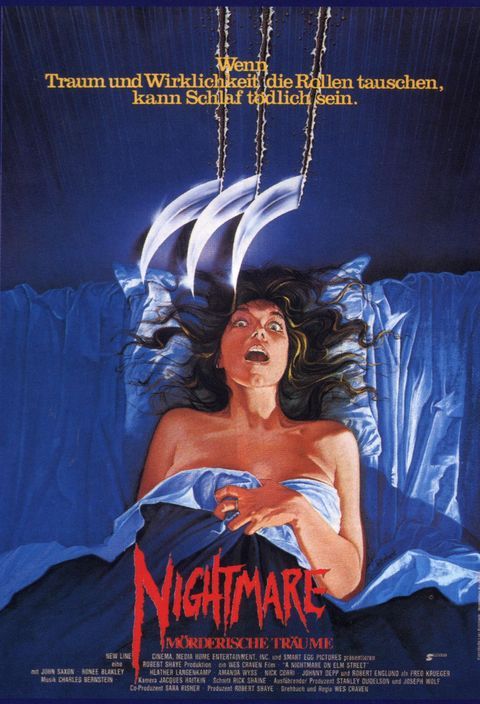
In 1984, Wes Craven, the director who had risen to prominence with films such as THE LAST HOUSE ON THE LEFT and THE HILLS HAVE EYES, decided to reinvent the Slasher Film.  Craven avoided the silent, stalking killer that typified the movie Slasher.  His creation was instead a wisecracking spectre, the ghost of a pedophilic child-killer haunting the dreams of the children of those who killed him.  That killer’s name was Freddy Krueger, and the movie was A NIGHTMARE ON ELM STREET.

Boasting an excellent script (by Craven), superb photography, and Craven’s usually strong direction, A NIGHTMARE ON ELM STREET became the template for a new direction in Horror over the next decade.  Less a Slasher than a supernatural demon, Krueger, played to perfection by Robert Englund, was the prototype of a new class of screen monster.  Englund was backed up by strong performances from a cast composed of veterans and newcomers, people such as John Saxon, Ronee Blakely, Heather Langenkamp, and Johnny Depp, in his first screen role.

The influence of A NIGHTMARE ON ELM STREET continued to be felt on the genre for the remainder of the decade.  Similarly-themed creatures, hellspawns, and demons, from THE LEPRECHAUN, to THE WISHMASTER’s Djinn, to Pinhead, the leader of HELLRAISER’s Cenobites, began to push the traditional Slasher Film aside.  While they retained many elements of the Slasher Films, their victim pools typically skewed older than those for the Slashers.  As the Slasher Film waned in popularity (though never disappearing completely) through the late 1980’s and early 1990’s, High Schools and Colleges became somewhat safer, though not totally safe, from the predations of masked killers and silent stalkers.

By 1996, the Slasher Film genre was ripe for reinvention, and once again it was Wes Craven, working with a script from Kevin Williamson, who called class back into session, with the hip, witty, self-aware Slasher hit SCREAM.

Starring Neve Campbell, Drew Barrymore, Courtney Cox, David Arquette, and Matthew Lillard, SCREAM stood the conventional Slasher genre on it’s head, poking fun at the form while still managing to be a very effective Horror Film.  Released on 20 December 1996, it got off to a slow start, earning just $6.4 million of its $15 million budget in that first week.  By the end of it’s third week in release, however, it was approaching $40 million in Box-Office receipts, and, much as A NIGHTMARE ON ELM STREET had done twelve years previously, had redefined the Horror Film.  Almost overnight fans were witness to what I refer to as the “Dawson’s Creek meets Freddy Krueger” School of Horror Films, movies which introduced a new paradigm to the Slasher Film.  Gone were the old stereotypes of the Slasher Film victims; now new models were introduced.  The average Slasher Film victim was no longer anyone most of us would have been familiar with when we were horny, stumbling, mumbling, pimply-faced youths surviving the daily pain-in-the-ass that was secondary education.  They were uniformly good-looking, uniformly wealthy, uniformly cool—and uniformly boring.

The few characters that existed outside the paradigm, be it due to lack of money, lack of looks, or lack of cool, were there to serve one of two purposes.  One, they were there to provide early fodder for the killer, and would quickly find themselves chopped, hacked, sliced, and/or diced into body count stew.

The second purpose such characters served was to provide a few red herrings as to the identity of the killer, who in the new paradigm wasn’t some escaped lunatic or mutant son of an insane camp counselor.  The killer in this new model Slasher Film came from within.  This new paradigm soon dominated the Horror genre, with SCREAM giving birth to two (soon to be three) sequels, along with numerous take-offs, such as URBAN LEGEND, I KNOW WHAT YOU DID LAST SUMMER, and the most original of these, FINAL DESTINATION.

However, lest one believe that the only danger to be found in the hallowed halls of academia were hook-handed Slashers and machete-wielding maniacs, in 1998 director Robert Rodriguez took us on a field trip back into the 1950’s, the heyday of the Alien Invasion movies such as IT CAME FROM OUTER SPACE and INVASION OF THE BODY-SNATCHERS, with THE FACULTY.

Starring Robert Patrick, Salma Hayek, Josh Hartnett, and Clea DuVall, this story of a High School where the faculty has been taken over by alien invaders was scripted by the same Kevin Williamson who had previously written SCREAM for Wes Craven.  While it did moderately well at the Box-Office, it failed to become the genre-changer that SCREAM had been two years before.

Another High School Horror Film failed at the Box-Office, but became a cult hit in video release.  2001’s GINGER SNAPS, a Canadian Werewolf movie directed by John Fawcett, and written by Karen Walton and Fawcett, saw only limited theatrical release in the US, though it did well in its native Canada.  It was also well-received by critics, and soon developed a solid fan following.  It stars Emily Perkins and Katherine Isabella as Brigitte and Ginger Fitzgerald, teen-age sisters struggling with feelings of depression and alienation while growing up in the small town of Bailey Downs.  The girls are obsessed with death, to the point of photographing themselves in staged ‘death scenes’ for a class project.  One night they encounter the “beast of Bailey Downs,” a creature the townspeople believe is responsible for a rash of mutilated dogs that have been found in recent days.  Ginger is bitten by the beast, and soon it becomes obvious to her sister that puberty isn’t the only change Ginger’s undergoing.

Though the genre had been trending away from the High School Horrors for several years, the recent spate of reinventions of many of the 1980’s Slasher Films has reinvigorated it to some degree.  HALLOWEEN, A NIGHTMARE ON ELM STREET, even PROM NIGHT have been remade lately, with varying degrees of success.  The audience for the Slasher Film hasn’t changed, demographically speaking, to any significant degree since the 1970’s, and in truth, neither have the long line of on-screen victims.  Both keep going strong, and that, I’m happy to say, shows no sign of changing.

“The Best [Euro-Horror] Movies You’ve Probably Never Seen”

For fans of European Horror Films, Amando De Ossorio is one of the legendary directors of the sub-genre.  Not as well-known as Fulci or Argento, not as prolific as Franco or as talented as Bava, he nonetheless is remembered as one of the greatest European film-makers ever, based solely on his iconic creations, the Knights Templars of the BLIND DEAD series of films.
Beginning in 1971, with the release of LA NOCHE DEL TERROR CIEGO  ~aka~  TOMBS OF THE BLIND DEAD, a unique form of undead menace graced the screens of theaters and Drive-Ins in Europe and North America.  While similar in style to the Romero Zombie-Verse of NIGHT OF THE LIVING DEAD, De Ossorio’s Satan-worshipping, blood-drinking, flesh-eating Knights of the Egyptian Cross were in a class all alone.  Evil in life, they became even more so after death, chasing down victims on gray-black spectral chargers, hunting them down by the sound of their beating hearts.
Based on the historical Crusaders known as Knights Templars, De Ossorio’s version, to put it mildly, deviates significantly from the historical record.  These Knights are a cult of Devil-worshippers, executed for their crimes, blinded so they could not threaten people, even after death.  But neither killing nor blinding them kept them from seeking out fresh prey through a series of four films from 1971 to 1975, continuing from the first with EL ATAQUE DE LOS MUERTOS SIN OJOS  ~aka~  RETURN OF THE BLIND DEAD; EL BUQUE MALDITO  ~aka~  THE GHOST GALLEON; and LA NOCHE DE LAS GAVIOTAS  ~aka~  NIGHT OF THE SEAGULLS.
While the quality of the series varied from film to film, hitting it’s nadir with the very weak EL BUQUE MALDITO in 1974, it was always stylish and atmospheric, highlighting De Ossorio’s talent as a director and photographer if not as a screenwriter.  The best of the series, at least in my opinion, was 1972’s EL ATAQUE DE LOS MUERTOS SIN OJOS.  Not only does it retain the stylistic elegance of the first film, but throws in some of the best action scenes of the series, including a suspenseful scene where the survivors of the initial Templar massacre struggle to rescue a young child caught outside with the dead knights.
Now those of you who are regular readers of this column know that I’m a big fan of Euro-Horror, and you probably know why.  The answer is a simple one:  Innovation.
Let’s examine one year, a year that featured the release of several landmark Horror Films—1960.  While Hollywood was churning out such blockbusters as THE AMAZING TRANSPARENT MAN and THE LEECH WOMAN, European film-makers were producing bona-fide classics like ET MOURIR DE PLASIR  ~aka~  BLOOD AND ROSES and LA MASCHERA DEL DEMONIO  ~aka~  BLACK SUNDAY.  Does that mean there were no good American Horror Films produced that year?  Hardly.  Am I trying to imply that Hollywood was totally incapable of original, innovative Horror?  No, though that statement’s not far from the truth.  One of the greatest, most innovative Horror Films ever made, Hitchcock’s PSYCHO, came out in 1960.  THE TIME MACHINE and THE FALL OF THE HOUSE OF USHER were also excellent 1960 releases, though neither was exceptionally innovative or original.
Innovation, though, is something that Hollywood finds itself unwilling to do.  Whether from fear of failure, or lack of imagination, Hollywood simply cannot get its collective thumb out long enough to come up with an original thought.  While this syndrome has become more pronounced of late, it’s hardly a recent phenomenon, as demonstrated by our look at 1960.
However, European directors felt no such constraints… or if they did, they didn’t let them affect the quality of their work.  Directors like Bava, Argento, Fulci, Rollin, and Franco may not have always been successful, but they made movies that were unmistakably their own, films that stood apart from the common herd.  You may not have liked their work, but you damn sure recognized it as theirs.
De Ossorio was that type of director.  Though his movies have their share of detractors, and his themes left him open to personal attack, (most often describing him as “misogynistic”…) he made the films that he wanted to make, and they were unlike anything else.  From the history he constructed for the Templars, to the distinctive design of their reanimated corpses, even to the unique method of filming the Blind Dead Knights in slow-motion that so effectively imparted a sense of the unreal, an air of supernatural, to the Templars, these films were different.  The combination of these factors, and others, have made these films some of the best of European Horror, even though few Americans are, or rather, were, familiar with them.  And those who have seen them probably saw a heavily edited VHS release, which could hardly convey the true quality of De Ossorio’s work.
That hopefully changed in 2005, when Blue Underground released an absolutely breath-taking boxed set, The Blind Dead Collection.  Beautifully restored to their original release condition, with the original language tracks in place, it’s easy to see just why these films were so highly thought of when they first hit the screens of European cinemas.  By the time they reached the American Drive-Ins and Grindhouses, cuts had already been made that reduced the films’ effectiveness.  The movies were each cut further in order to fit into broadcast slots, as well as making them Television friendly.  Along the way, De Ossorio’s original concepts became so muddied and disguised that in direct comparison, they seem like different films.
And thanks to Blue Underground, that direct comparison, at least for LA NOCHE DEL TERROR CIEGO, is easily accomplished.  In addition to the original wide-screen Spanish release of De Ossorio’s masterpiece, they’ve included the edited, dubbed, pan-and-scan U.S. video release in its entirety.  Watching them back-to-back, as I did recently, only made me appreciate the original all the more.  The plot, which seems to make little sense in the edited version, jumps into crystal clarity in the original.  Though I speak not a word of Spanish, the dialogue between the principal characters became far more comprehensible in the original, sub-titled version than in the one where I could actually understand what the actors were saying.
When I say that these are the best Euro-Horror films you’ve never seen, I’m fully aware that many of you probably have seen them; may even have the beat-up, fading VHS’s in your collection, just as I did.  You might even now be composing angry e-mails, ready to inform me just how big a fathead I am.  Fine.  But unless you’ve seen these movies the way they were meant to be seen, the way De Ossorio wanted them to be seen, then just hit that delete button.
Because, unless you have seen them in their original form, they are the best Euro-Horror movies you’ve never seen.

DVD Review: THE PROWLER

Title:  THE PROWLER

Year of Release—Film:  1981

Year of Release—DVD:  2003

DVD Label:  Blue Underground


The early ‘80’s were the height of the Slasher movie craze, and 1981 was perhaps the high-water mark of the genre, with no fewer than thirteen different Slasher Movies being released.  These ran the gamut from the superb—PIECES ~aka~ ONE THOUSAND CRIES HAS THE NIGHT and MY BLOODY VALENTINE, to the average—HALLOWEEN II; HAPPY BIRTHDAY TO ME, to the execrable—HUMONGOUS; HONEYMOON HORROR.  And a 17-year-old Unimonster was there in the theaters for most of them.  FUNHOUSE, FRIDAY THE 13TH, Part II and HE KNOWS YOU’RE ALONE were just a few of the movies that I saw that year, by any measure a very good year for Slasher-fans.

But one that escaped my notice until just recently was Joseph Zito’s THE PROWLER, available on DVD from Blue Underground.  My introduction to this movie came while viewing the superb documentary on Slasher films, GOING TO PIECES: THE RISE AND FALL OF THE SLASHER MOVIE [Starz/Thinkfilm].  THE PROWLER was one that the documentarians focused on, including interviews with the director and behind-the-scenes footage of the film’s special effects and make-up creator Tom Savini.  What they described was a complete unknown to me, and it intrigued me enough to begin hunting for a copy of this movie.

It’s June 1945, and the war in Europe is over.  Hundreds of thousands of GI’s are returning to the States, most to pick up their lives pretty much where they left off.  Others however, the thousands of ‘Dear Johns’ dumped by their wives and sweethearts while they fought for freedom, are coming home to piece shattered lives, and in many cases shattered psyches, back together.  In Avalon Bay, the former sweetheart of one such ‘Dear John’ is attending her graduation dance with her new beau.  They slip out to share a quiet moment alone, only to be brutally murdered, impaled together on a pitchfork by a helmeted, masked killer in combat fatigues.

Thirty-five years later, the school is preparing for it’s first graduation dance since the night of the double murder.  The Sheriff (Farley Granger, in what amounts to a brief cameo…) is departing on his annual fishing trip, leaving the town in the hands of his deputy (played competently by Christopher Goutman).  He and his girlfriend Pam (the lovely Vicky Dawson, in an underwhelming performance) discover that a killer is once again stalking the graduation dance, and that his next target might be Pam herself.

While the premise is nothing original, borrowing heavily from earlier entries in the Slasher genre, the execution is far better than most.  Zito’s direction never lets events wander too far afield, and the pacing is well managed.  The script, by Neal Barbera and Glenn Leopold, provides a better than average starting point for that direction, and the cast of unknowns does a decent job with the material they’re given.  Though the film features a pair of former stars in cameo roles, (the above-mentioned Granger and Lawrence Tierney as Col. Chatham, father of the girl murdered in 1945…) their contributions are minimal.  The true star of the film is the make-up effects of Tom Savini.

From the pitchfork murder of one young woman in her shower, to the swimming pool throat-slitting of another, to the climactic death scene, Savini’s effects work elevates this movie above it’s contemporaries.  When it comes to blood and gore exploding across the screen, no one does it better than Savini; it’s a shame that he has apparently forgotten this aspect of his career in order to pursue acting and directing.

The DVD comes with several bonuses that are worth checking out, most notably a behind-the-scenes reel of Savini’s team setting up and performing the effects shots.  Tidbits such as that are always fascinating.

THE PROWLER is a movie that escaped my notice the first time around, but I’m pleased to say that I have discovered it at last.  For those who enjoy a good, old-fashioned Slasher pic, it’s one that’s hard to beat.  I’d call it a definite rental; a buy for fans of the genre.

DVD Review: BLACK CHRISTMAS (2006)

Title:  BLACK CHRISTMAS (2006)

Year of Release—Film:  2006

Year of Release—DVD:  2007

DVD Label:  Dimension Home Entertainment


Bob Clark, the director who was recently killed by a drunk driver, will forever be known for what must be the best Christmas movie I’ve ever seen, 1983’s A CHRISTMAS STORY.  The tale of young Ralphie Parker and his quest for an official Red Ryder, 200-shot, Range Model Air Rifle, (with a compass in the stock and this thing that tells time…) the film is one of the most humorous and heart-warming I’ve ever seen, capturing perfectly experiences that are common to most children, regardless of era.  Clark also helmed another of my favorite comedies, released in 1980—PORKY’S.  This raunchy, risqué teen sex-comedy is one that I never seem to tire of watching.

However, before he became known for his comedies, Bob Clark was one of the new breed of independent Horror directors, a contemporary of Wes Craven, Tobe Hooper, Curtis Harrington, and Larry Cohen, that burst on the scene in the early ‘70’s following the success of George Romero’s NIGHT OF THE LIVING DEAD.  Without the constraints of a major studio production, these filmmakers were able to push the envelope in ways heretofore unexplored.  Most of their efforts were, quite frankly, less than successful; Clark’s own first feature, 1972’s CHILDREN SHOULDN’T PLAY WITH DEAD THINGS, was a thoroughly unmemorable, though mildly entertaining, rip-off of Romero’s NOTLD.  His next film however, DEATHDREAM, was much improved; and in 1974 he laid the foundation for the Slasher genre with BLACK CHRISTMAS.

Set in a sorority house over the Christmas break, as a lunatic hiding in the attic hunts those young ladies who didn’t go home for the holidays, this film laid down several of the conventions that would be developed further four years later with the masterpiece of the Slasher film, John Carpenter’s HALLOWEEN.  Now, Glen Morgan has remade what is arguably Clark’s best Horror Film, with both Clark’s blessing and his imprimatur as Executive Producer.

This new version is faithful to the original, without being a shot-by-shot restaging of it.  It also answers many of the questions that were purposefully left unanswered in the 1974 version.  This has a mixed result; part of what the fans remember about the original film is the vagueness of the ending, and I think that leaving some secrets buried would have been a better choice.  But today’s horror fans seem to prefer their loose ends neatly tied together, and gathering the threads probably produced a more ‘commercial’ film.

The story of the killer, Billy, is told in a series of flashbacks to his childhood in the home that later became the Sorority House.  His abusive mother kills his loving father, setting the pattern for the young boy’s psychopathia.  As an adult, he eventually kills both her and her second husband, and is busy devouring her when the police arrive.  Committed to a mental institution, he escapes, heading back home… to what is now the Delta Kappa Alpha house.

The cast is good, though not spectacular, and the young women of the sorority are certainly beautiful.  Though most of the faces are familiar to viewers, there are no household names present, not that the material really requires much star power.  Morgan’s direction is competent; nothing inspired, but smooth and capable.
While remakes are difficult to pull off successfully, Morgan and co. do a very good job here.  Perhaps it has more to do with the lack of familiarity most fans have with the original, never a big commercial success, than with the changes inherent in this version.  Still, for whatever the reason, BLACK CHRISTMAS works, and works very well.

My disc is the special BlockBuster Video© Unrated Edition.  How this differentiates it from any other Unrated Edition escapes me, but no matter.  Dimension usually does a good job packaging their films, and this example is no different.  The audio and video quality was good, and the disc had a full selection of sound and subtitle options.

The release has several excellent features that should please viewers.  There is a very good behind-the-scenes documentary that includes comments from Bob Clark.  I would imagine these were among his last comments on his early horror films, as his death came not long after the DVD’s release.  Concerning his early films, he remarks that, in order to break into the business, you had to either “…make pornos, or make horrors.  And I didn’t want to make pornos.”  The documentary stands as a far more interesting look at this talented director than as a look at the making of BLACK CHRISTMAS.

Perhaps the best of the special features are the three Alternate endings; at least one of which would have been an improvement over the ending of the U.S. released version.  (The International release had one of these alternate conclusions…)  These are presented in sufficient depth and detail to allow a true comparison to be made, and each viewer to make their own choice.

In my “2006 in Review” column over at www.creaturescape.com, I discussed this film in conjunction with my look at the Remake of the Year, and stated that I had heard good things about this film but would reserve judgment until I had seen it myself.  Well, I’ve finally seen it, and must admit that I was very pleased.  It’s rare that I see a remake that I enjoy, and one that exceeds and expands upon the original is rarer still.  This one does just that, and does it with some flair and a dash of originality.  Not much, but enough to make a difference.

I got my copy from the four for $20 bargain bin at BlockBuster Video, (a definite recommendation, I might add…) but even at the list price it’s worth consideration.  I say give it a try… and have a scary Christmas.

05 June, 2010

Returning to Crystal Lake: Remaking FRIDAY THE 13TH

Once again, Hollywood has proven that there is a total dearth of originality in the film industry, by remaking a film that was hardly original when it premiered 30 years ago. Sean Cunningham’s FRIDAY THE 13th, while a breakthrough film for American audiences, was familiar ground for fans of Euro-Horror, especially the Italian Giallos. F13 freely borrowed elements from the work of such directors as Dario Argento, Antonio Margheriti, and Mario Bava, most notably Bava’s terrific REAZIONE A CATENA ~aka~ A BAY OF BLOOD. This 1971 film features several thematic similarities to F13… the isolated rural setting, the escalating body count, the inventive means of killing the various victims. F13 adopted these conventions, translating them into forms more familiar to American audiences. In many ways, FRIDAY THE 13TH is the quintessential American Giallo.

F13 also owed much to two North American films from the ‘70’s. A talented young director named Bob Clark, who previously made DEATHDREAM and CHILDREN SHOULDN’T PLAY WITH DEAD THINGS, created the Slasher genre with 1974’s Canadian import BLACK CHRISTMAS, the best of his early films. Clark, who would become famous with Comedies such as PORKY’S and A CHRISTMAS STORY, had a talent for Horror that few appreciated at the time, primarily because he never had a budget to match it. In that respect, BLACK CHRISTMAS was the perfect film to showcase that talent: Cheap to produce; not reliant on special effects; and a better script than his previous outings. The caliber of the acting was also much improved, as he was able to move away from some of his stock performers he had been using since his earliest work.

This film went far in establishing the look and feel of the modern Slasher film, as well as several of the conventions that would become hallmarks of the genre. A small, isolated group, young, attractive, cut off from contact with the outside, menaced by a hidden killer from within what should be a safe and comforting shelter… all would become familiar to fans of the Slasher genre, and all started here.

The second film that inspired Cunningham, even more directly, was the surprise 1978 hit HALLOWEEN. Produced by Moustafa Akkad, and the directorial debut of soon-to-be Horror Master John Carpenter, HALLOWEEN introduced fans to a new concept in Horror, the Unstoppable Slasher. These nightmare creations, more than psychopaths, less than monsters, were relentlessly evil, indestructible, silently emotionless killers. Their only motivation, their only drive, was to kill. Not out of hunger, not for greed. They’re unstoppable killing machines, with absolutely no humanity whatsoever. No motive, no remorse, nothing to moderate the pure… EVIL of the monster. Michael Myers wasn’t some crackhead knocking off a liquor store to get his next fix; he’s not a mobster killing for profit. His only motivation is to kill. No food, sex, or rest. Just… Kill.

With F13, Cunningham took elements of both, and added a unique twist: the location. Camp Crystal Lake defined the franchise from the beginning, even before there was a Jason Voorhees. In truth, Crystal Lake was responsible for the “death” of the boy Jason, and the derangement of his mother Pamela, the killer in that first film. Crystal Lake was a prominent feature of each of the sequels until FRIDAY THE 13TH VIII: JASON TAKES MANHATTAN, easily the nadir of the series. This symbiotic relationship between Jason and Crystal Lake was explored in detail in Ronny Yu’s 2003 film FREDDY vs. JASON.

Recently, director Marcus Nispel helmed a return trip to the place where it all began. FRIDAY THE 13TH, the remake, was released on the 13th (a Friday, naturally…) of February 2009, and is now available on Warner Home Video DVD [DVD Review: FRIDAY THE 13TH (2009): The Killer Cut, see below]. Nispel, who directed the successful, if inferior, remake of THE TEXAS CHAINSAW MASSACRE (2003), beat out Jonathan Liebesman, the director of THE TEXAS CHAINSAW MASSACRE: THE BEGINNING (2006), for the honor of helming this film. Platinum Dunes, the company responsible for that recreated franchise, partnered with New Line Cinema, who acquired the rights to the original series from Paramount following the dismal showing of the aforementioned FRIDAY THE 13TH VIII: JASON TAKES MANHATTAN. New Line produced three films, JASON GOES TO HELL: THE FINAL FRIDAY (1993), JASON X (2001), and FREDDY vs. JASON (2003) [DVD Review: FREDDY vs. JASON, see below], and while the first two were inexcusably bad, the third went a long way towards redeeming the franchise. Combined with New Line’s blockbuster NIGHTMARE ON ELM STREET franchise, and it’s star slasher, Freddy Krueger, the saga of Jason Voorhees underwent a renaissance, as well as a deeper exploration of it’s roots.

One characteristic of the recent ‘reinventions’ of some of our favorite horror franchises—HALLOWEEN, TEXAS CHAINSAW MASSACRE, THE HILLS HAVE EYES—is that the reinventions somehow can’t resist filling-in the ‘dark places’ in the originals… the unanswered questions, the voids in the narrative that we were allowed to fill in with our imaginations, creating scenes far more frightening than the filmmakers were capable of. They feel the need to answer every question, to expose every ‘dark place’ to light, and in the process ruin what made those original films so unique and memorable.

Those who viewed the Rob Zombie-directed 2007 remake of HALLOWEEN were given every possible insight into the creation of Michael Myers, the killer—but the result was the destruction of Michael Myers, the inhuman, unknown, unstoppable Slasher. As I discussed in my review of the film—

“Where in the 1978 film Michael Myers had been an enigma, a cipher, (he was even listed as “The Shape” in the credits…) here Zombie gives depth and humanity, albeit flawed, to Michael by exploring in great detail his troubled childhood and incarceration. What was only alluded to in the original is played out over the entire first act here, bringing us into Michael’s world, and letting us get to know him. It is not an equitable trade.

“Part of what has made the original HALLOWEEN such a classic of the genre was that mystery, that air of the unknown that cloaked Michael Myers. When Donald Pleasance, as Dr. Loomis, describes Michael as a being of pure evil, it’s easy to understand, and believe, the good doctor. When Malcolm McDowell says the same thing in his performance as Loomis, the words sound hollow and overwrought, and we wonder whom he’s trying to convince.” [DVD Review: HALLOWEEN (2007) Unrated Director's Cut, 23 February 2008]

That first paragraph could be used to describe any of these recent remakes. All are guilty of that, and true to form, Nispel’s F13 doesn’t resist the urge to delve into Jason’s psyche, though to a much lesser degree than Zombie’s HALLOWEEN redo. Steve Miner’s (the director of FRIDAY THE 13TH, Pt. II…) Jason Voorhees, more than any of that generation of slashers save Wes Craven’s Freddy Krueger, was a supernatural creature, an evil spawned by Hell and birthed by Crystal Lake. He killed because that was what he was—a killer. No motivation other than his own nature was required. That’s something that could be said for the other original Slashers… Michael, Freddy, Leatherface… their nature was to kill, and their creators wisely decided to remain silent on the state of their subconscious.

Not only is it unnecessary to attempt some manner of on-screen psychoanalysis on the likes of Michael Myers or Jason Voorhees, the humanization of such characters destroys that which makes them unique: Their inhumanity—the fact that they are inhuman, unnatural, unstoppable forces of evil, incarnate on Earth for the sole purpose of spreading death and terror. Without that to set them apart, there is no difference between them and Norman Bates—just deranged psychopaths, scarred, traumatized human beings, giving in to their twisted urges. The supernatural aspect of the killers who cannot be killed is gone. The characters are no longer the monsters of our formative years; they are now simply the garden-variety serial killer, albeit more prolific. The filmmakers ramped up the gore and violence, but in the process they lost the ability to instill terror in the audience. You can shock them with violence, and gross them out with gore, but only by creating something beyond normal criminal behavior do you create the sense of horror that keeps audiences coming back for thirty years. In thirty years, Carpenter’s HALLOWEEN and Cunningham’s F13 will still be classics of the Horror genre. I doubt the same will be said about the remakes.


Posted by Picasa

DVD Review: FRIDAY THE 13TH (1980)

Title: FRIDAY THE 13th

Year of Release—Film: 1980

Year of Release—DVD: 1999

DVD Label: Paramount Home Video

In the world full of Horror Franchises, none have stood the test of time as well as the FRIDAY THE 13th franchise. Twelve films, a TV series, video games… for 29 years now, Sean Cunningham’s iconic slasher Jason Voorhees has dominated the modern Horror scene, outdistancing even his closest competitors, Michael Myers and Freddy Krueger. However, few remember that, when it all began, before there was a killer named Jason, there was his grief-deranged mother Pamela, and the first blood-bath at Camp Crystal Lake.

Following the success of John Carpenter’s HALLOWEEN, which major studios ignored but went on to earn millions—in a series of regional releases—for Cannon, the heads of the various majors began to reconsider their objection to distributing Horror Films, especially Slasher films. Paramount was the first out of the gate, with a low-budget film written and directed by Sean Cunningham. Cunningham, who made a name for himself producing Wes Craven’s LAST HOUSE ON THE LEFT in 1972, took a different approach to the Slasher Film than Carpenter had with HALLOWEEN. While Carpenter had built his movie on suspense, minimizing the blood and gore, Cunningham hit the viewer head on with them, in new, imaginative ways.

The plot, what there is of it, is almost superfluous. It exists merely to place the characters into the situations that lead to their violent, gory deaths. Decades after two camp counselors were brutally murdered at Camp Crystal Lake, the son of the original owners decides to reopen it for the Summer season. With the help of some teen-agers from the city, he begins to ready Camp Blood, as the locals have christened it, for a new group of campers. However, soon his counselors start to disappear into the woods surrounding the camp, as Camp Blood begins to live up to its ominous nickname.

There are many reasons that this film became the standard-bearer for the Slasher sub-genre—the inventive, over-the-top death scenes, the huge body count, the copious amounts of blood, gore and nudity—all no doubt contributed greatly to the film’s success. The film is very much an American Giallo, sharing many features and plot devices with those staples of Italian cinema. Indeed, many similarities exist between FRIDAY THE 13TH and Mario Bava’s classic 1971 thriller REAZIONE A CATENA ~aka~ A BAY OF BLOOD. The setting by the water, the creative modes of inflicting death upon the ever-growing body count, and the shock ending are only a few of these similarities.

Paramount Home Video’s 1999 DVD has been superseded by a newer release with additional materials, nice to have but not really necessary. The original presentation is adequate for viewing the movie, and, as it came in a set of the first three films in the franchise, for less than $10, I have no complaints about the paucity of features on the disc. Paramount Home Video seldom goes overboard on bonuses for it’s customers, and this disc is certainly no exception to that rule.

Still, as I said it is sufficient for viewing the film, and that film is one of the seminal movies of the Slasher genre. Not as good as HALLOWEEN certainly; and we wouldn’t gain the series’ iconic “man in the mask” until the sequel a year later, in the person of Jason Voorhees. That sequel would transform its predecessor, a little, low-budget summer movie that defied critics, astounded studio executives, and amazed audiences, into a franchise that is still going strong today. The importance of FRIDAY THE 13TH, Pt. II notwithstanding, the original is by far the better movie. It’s also a film that every Horror fan must own in some form.


Posted by Picasa