Welcome to the Crypt!

Welcome to the Crypt!

Enter the Crypt as John "The Unimonster" Stevenson and his merry band of ghouls rants and raves about the current state of Horror, as well as reviews Movies, Books, DVD's and more, both old and new.

From the Desk of the Unimonster...

From the Desk of the Unimonster...

Welcome everyone to the Unimonster’s Crypt! Well, the winter’s chill has settled into the Crypt, and your friendly Unimonster won’t stop shivering until May! To take my mind off the cold, we’re going to take a trip into the future … the future of Star Trek! Star Trek was the Unimonster’s first love, and we’ll examine that in this week’s essay. We’ll also inaugurate a new continuing column for The Unimonster’s Crypt, one written by the Uni-Nephew himself! This week he examines one of his favorite films, one that, quite frankly, failed to impress his uncle, Jordan Peele’s Nope. So enjoy the reading and let us hear from you, live long and prosper, and … STAY SCARY!

Popular Posts

Followers

Essays from the Crypt

Essays from the Crypt
Buy the best of the Unimonster's Crypt

Search This Blog

Showing posts with label British Horror. Show all posts

05 January, 2024

A Haunted House, English-Style


The British Horror film, and indeed, Great Britain’s entire film industry, was teetering on the brink of the precipice by 1973, brought on in part by the faltering national economy.  In the words of Sinclair McKay, “By 1973, it was not merely the old British film industry that was in a state of outright crisis; the entire nation was.”  Hammer, with Michael Carreras now firmly in control, was in a steady decline, much like an aging senior citizen, in whom one illness rapidly leads to another, and another.  That year saw the release of only one classic Hammer Horror, possibly the worst of them all; the film that made Christopher Lee hang up the cloak and put away the fangs for good—The Satanic Rites of Dracula.

Fortunately, other companies were in there pitching, and doing a much better job than Hammer’s anemic efforts.  In fact, 1973 would see the release of two very good British Horrors, The Legend of Hell House and The Vault of Horror, and one that is the best British Horror film of the decade; perhaps the best Brit Horror ever—The Wicker Man.  I have discussed that film, and my reverence for it, at length in this column.  For now, we’ll examine John Hough’s excellent Horror film, The Legend of Hell House.

Following his departure from American-International Pictures, the company that he had founded with Samuel Z. Arkoff nearly twenty years before, James H. Nicholson started Academy Pictures Corporation, in partnership with 20th Century Fox, with plans to co-produce five films.  The first would be an adaptation of Richard Matheson’s sexually charged novel, Hell House.  Matheson would write the screenplay, toning down some of the more graphic sexual elements, transforming it into something suitable for the screen, and John Hough was tasked to direct the film.  Hough, who had recently directed Twins of Evil at Hammer Films, was a good choice; he was a solid, competent, and reliable director, the type needed to bring low-budget productions in on-time and on the money.

It is Friday, December 17th, and Dr. Lionel Barrett (Clive Revill), a British physicist and researcher into paranormal phenomena, has been summoned to a meeting with Mr. Deutsch (Roland Culver), an elderly millionaire, who has a proposition for the scientist:  prove or disprove the soul’s survival after death.  Do so, either way, and earn £100,000.  There are two stipulations, however.  He must begin on the following Monday, the 20th, and he has only five days.  Five days to prove or disprove life after death.

Barrett is intrigued, but how can he accomplish that task, one that, on the surface, would seem impossible?  Deutsch’s answer is simple, though unexpected.  He must go to the one place where the possibility of survival has not been refuted.  Belasco House—Hell House.  Two previous teams have investigated the mansion; eight members of the two expeditions died.  There was only one survivor, from the last group twenty years before.  That man, Ben Fischer (Roddy McDowell), will go with Barrett to the house, as will another medium, a young woman named Florence Tanner (Pamela Franklin).  Barrett’s wife Ann (Gayle Hunnicutt) will accompany him as she usually does on his investigations, though he warns her that this will not be like any other “haunted house,” calling Hell House the “Mt. Everest of haunted houses.”

The following Monday, the group arrives at Hell House to begin their investigation.  Florence is immediately affected by the entities present in the house, though the other psychic, Ben, keeps himself closed off.  However, the two mediums aren’t the only ones experiencing unusual reactions.  Ann Barrett, a sexually frustrated woman due to her husband’s inattentiveness, begins walking in her sleep, and behaving most improperly towards Ben.  Everyone seems under some form of attack, though Florence is particularly vulnerable.  The attacks on both women are personal, and sexual, in nature.  Barrett believes that the former owner, Emeric Belasco, was such a vain, cruel, evil man, and the litany of sins he practiced and encouraged steeped the house in so much malevolent energy, that it has become like a massive battery, providing anyone with innate psychic abilities with a surge of uncontrollable power.  There are no ghosts, no surviving spirits, just the untapped potential of the human mind.  Ben is convinced it is the spirit of Belasco himself, and though Florence agrees that it is a spirit, she’s not sure it’s Belasco’s.

As the week wears on, the attacks become more violent and aggressive.  Barrett is nearly killed.  Florence is raped by what she believes is a spirit.  Slowly, however, they uncover the secrets of Belasco House, including the discovery of the chained-up body of Belasco’s son Daniel, concealed behind a brick wall.  As the week draws near its end, Barrett has plans to fight back—a machine of his invention that will counter the energies in the house, clearing the house of its stored ability to cause harm.  If his theory is correct.

Reviews were mixed for the film, though generally not positive.  Mick Martin, writing for the magazine Cinefantastique, seemed to speak for his fellow critics.  “So much that made the book a blockbuster horror story is left out of the film that I find it impossible to view it objectively, especially after experiencing The Exorcist.”  The comparison to the far superior film may be a natural one, one I’m certain many critics couldn’t help but make.  As natural as that comparison may be, however, it did no favors for The Legend of Hell House.  Though the box-office numbers for the film were decent, it was not the success for which 20th Century Fox and Academy Pictures could have hoped.  Appreciation for the film has grown in the intervening years, however.  Andy Boot, in discussing the film, lays its lackluster performance on a lack of promotional spending. 

“The last film of 1973 was one that could—shock for shock—rival The Exorcist.  The only thing letting it down was the budget—not because of the actual production quality, but simply because it could not be hyped ... This is the type of horror movie that is impossible to do justice in print.  Kinetic and visually stunning, it is a superb piece of craft that needs to be seen to be appreciated.”

James Nicholson (R), and Samuel B. Arkoff (L).

A significant difference from contemporaneous reviews, one might safely say.  The Legend of Hell House was the first film produced by Academy; there would be only one more.  In December of 1972 James Nicholson, the creative force behind the birth of Teensploitation and the Drive-In Movie, died of a malignant brain tumor.  His last production, Dirty Mary Crazy Larry, would be released eleven months after The Legend of Hell House.

19 February, 2012

Bobbie's Movies to Look For: ATTACK THE BLOCK

Title:  ATTACK THE BLOCK
 
Year of Release—Film:  2011


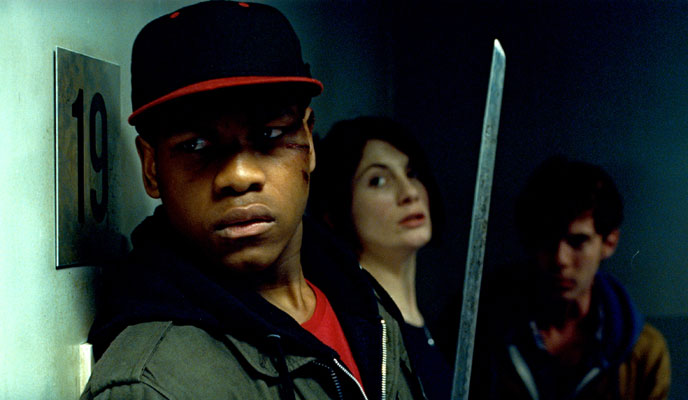
A small group of London thugs is interrupted in the process of mugging Sam, a nurse new to their council-flat block (British for public housing) by an explosion, followed by something crashing through a near-by car.  Sam beats a hasty retreat while the gang checks out the wreck and discovers something alive and unpleasant in it.  That something claws gang leader Moses’ face, scarring him, and escapes.  These wanna-be gangstas, angry at the interruption and Moses’ injury, track it down and kill it.  Then, they parade their find through the darkened streets like some kind of smelly trophy.  And for some reason they don’t figure out until late in the film, a second wave of alien monsters—described vaguely as “gorilla-wolf-looking” creature—is out to get them!  Quite by accident, they wind up in Sam’s apartment where they find themselves uneasy allies with their previous victim against these unknown, blacker-than-black beasts with glowing fangs.

Fans of science fiction know that the bad guys always get killed by the invaders from Space.  This is where ATTACK THE BLOCK differs when we, the audience, realize that the baddies are here to stay.  Understandably hesitant to get the authorities involved, these street-smart, profanity-slinging little criminals are ready to do what they have always done—defend their turf!  Even if that turf in the gritty, grimy high-rise flats they inhabit and the littered and graffitied streets that they nightly prowl.  Armed with everything from baseball bats to Super-Soakers to swords, they face down dozens of monsters that, for some unknown reason, want them dead!

Writer and director Joe Cornish is too savvy to excuse the teen’s violent behavior or suggest we shouldn’t condemn them.  Instead, he uses them as narrative objects and allows the audience to root for their survival.  However, instead of coming off as preachy or socioeconomic savvy, ATTACK THE BLOCK is a pulse-raising thrill-ride whose near perfect construction belies its director’s first-time status.  All but one of the gang’s actors are first-timers, a couple of whom—John Boyega as Moses and Alex Esmail as Pest—shine even in the presence of the more experienced actors.  SHAUN OF THE DEAD’s Nick Frost has a secondary role as the pot dealer and adds some much-needed stoner-humor.  The sets have the claustrophobic feel of small, tight spaces and darkened hallways.  The cast is kept to a minimum giving one the feeling that these young men are all alone in their fight against this extraterrestrial menace.  The payoff is the alien monsters that are crafted in an ingenious, scary and memorable way, easily the Best Movie Monster of 2011.

This is the movie indie moviegoers have been waiting for and it deserves all the praise it’s been getting.  It’s not your typical Hollywood remake filled with all the familiar Hollywood faces.  Sure, it’s formulaic but it does the formula right.  Hopefully, viewers will get a sequel that will not be spoiled by padding or CGI-heavy monsters.  And hopefully, the remake will star John Boyega, whom, I believe, has a great future in indie film.  See ATTACK THE BLOCK.  You’ll thank me.  Four stars.

MSTJunkie


08 May, 2011

Dracula Reborn: HORROR OF DRACULA and the Rise of Hammer


         The mid 1940’s to mid 1950’s was a period of decline for Classic Horror.  Monsters were no longer tuxedo-clad vampires or shambling, cloth-wrapped mummies.  Monsters were now gigantic insects, radioactive mutants, and alien invaders.  What vampires and werewolves were to be found were products of science tampering with nature, not the ancient undead or supernatural curses.

          Two prime examples of this are a pair of films released in 1957:  THE VAMPIRE, and I WAS A TEEN-AGE WEREWOLF.

          THE VAMPIRE, directed by Paul Landres, was a nondescript programmer from Gramercy Pictures, distributed by United Artists; not a terrible film, but hardly memorable.  A doctor, while on a quest to improve his mind, tries an extract of vampire bat blood, with predictable results. 

          Gene Fowler Jr.’s I WAS A TEEN-AGE WEREWOLF on the other hand, became something of a cult-classic, primarily because of the screen debut of a youthful Michael Landon rather than the film’s inherent quality.  Landon plays Tony Rivers, a juvenile delinquent placed under the care of a psychologist (Whit Bissell). 

          The psychologist performs some unauthorized experiments on the young man, using hypnosis to regress him to a point in man’s development where he is a savage, feral beast.  Here too, the results are entirely predictable and, for the junior wolf-man, unfortunate.

          Such was the state of our classic creatures of horror through most of the decade of the 1950’s.  But the pendulum was beginning to swing back towards the classics, and two unrelated events provided the impetus for that change of fortune.  The first was the release, in June of 1957, of Hammer Films THE CURSE OF FRANKENSTEIN, launching the British studio to the forefront of the horror genre.  Introducing Hammer’s Dynamic Duo of Horror, Christopher Lee and Peter Cushing, along with the studio’s star director, Terence Fisher, this film sparked a resurgence of interest in the classics, as well as changed the look of Horror Films.

          Hammer Film Productions had been around, in its then-current form, since shortly after the end of World War II.  A child of Col. James Carreras, Hammer was very much a small family business in the mid-1950’s, known primarily for crime, adventure, and war pictures.  Ensconced at Bray Studios, Down Place, in Berkshire, a small, tightly-knit group of artists and craftsmen would create some of the greatest Horror Films ever produced, working on budgets that were fractions of what was typical in a Hollywood production.

          They accomplished these miracles, at least in the beginning, through the efforts of a few very talented people, the people who created the “Hammer Look”… people such as Michael Carreras, the son of James, Tony Nelson-Keyes, Tony Hinds, and Jimmy Sangster.  Jack Asher’s superb photography brought the Hammer horrors to life, painted in brilliant colors across a canvas laid before the viewer by Bernard Robinson’s perfect production and art designs.

          THE CURSE OF FRANKENSTEIN was the film that established the pattern for the “Hammer Look”… bold, vibrant colors, lush period sets and costumes, and, at least at this point in time, quality acting, writing, and directing.  Peter Cushing, as the mad genius Dr. Victor Frankenstein, carries the film, creating a character at once evil yet complex, someone the viewer is unable to see completely as a villain.  Lee’s Monster, by comparison, is simply cruel and brutish, lacking any of the pathos and humanity of Karloff’s creation. 

          Philip Leakey’s make-up, constrained as it was by threat of legal action from Universal if it too closely resembled Jack Pierce’s trademarked conception, was generic and unimpressive, doing nothing to convey the monster’s origins the way Pierce’s did for Karloff.  Karloff looked like a patchwork, a being stitched together from rotting cadavers into a less than perfect whole; Lee, on the other hand, looked like nothing more than the common zombie that would populate Horror Films beginning little more than a decade later.  It was not an effective look.

          While the film was much closer in plot to Shelley’s original tale, it was all gloss and glitter; beautiful to look at, but lacking the heart and soul of James Whale’s landmark film, and wholly inferior to it.  This movie, like Hammer Films itself, was a gorgeous façade, with very little of substance supporting it.
 
          The second major development in the restoration of classic horror occurred in the fall of 1957, when Universal, through an arrangement with Screen Gems, released their Shock Theater package to Television stations around the country.  Composed of some of their greatest Horror Films, including FRANKENSTEIN, DRACULA, THE WOLF-MAN, and CREATURE FROM THE BLACK LAGOON, this led to an explosion of Hosted Horror programs on Friday and Saturday nights.  Though Horror Hosts had existed prior to the Shock Theater release, it was the flood of high-quality movies and the success of hosts such as Zacherley in New York and Vampira in Los Angeles that spurred stations from Atlanta to Minneapolis to develop their own late-night Horror shows.

          These trends continued into 1958, and on the 22nd of May of that year, at the Gaumont Theater in London, Hammer’s second blockbuster premiered.  HORROR OF DRACULA, once again directed by Fisher and starring Cushing and Lee, took the basic blueprint laid down by the previous film and set it in concrete, defining for the next twelve years the look and texture of classic horror.  Not until DRACULA A.D. 1972 was there anything more than a qualitative change in Hammer’s Dracula franchise, and decidedly not for the better.

          This time however there would be a clear choice between good and evil, as Cushing was cast as Dr. Van Helsing, the bloody Count’s nemesis.  Though he ably demonstrated that he could play evil convincingly in THE CURSE OF FRANKENSTEIN, it’s as the heroic Van Helsing that he found his greatest role. 

          Where, in 1931’s DRACULA, Edward Van Sloan had essayed an elderly, superstitious professor (for all his scientific training, Van Sloan’s character was little more than a village wise woman…), Cushing portrayed Van Helsing as a young, strong, active combatant against evil, seeking scientific explanations for the vampire’s existence, and scientific means to destroy him.  Universal’s Van Helsing was a teacher; Hammer’s was a warrior, and a worthy foe for the Prince of Darkness.

          And what a Prince of Darkness he faced.
 
          For more than a quarter of a century previously, Bela Lugosi’s portrayal of the eponymous Count from Bram Stoker’s novel had been the model that moviemakers followed, and moviegoers wanted.  The image of Dracula as an urbane, sophisticated gentleman, clad in black-tie formality, had become ingrained into the consciousness of Horror fans through multiple iterations of the Count and his clones. 

          Whether portrayed by Lugosi himself, Lon Chaney Jr., or John Carradine, the American image of the Vampire was that of Bela, in tie and tails, top hat and cape.  His Dracula had a slow, languid quality, almost hypnotic to watch.  It took no stretch of the imagination to picture a beautiful young woman falling victim to his spell.  Dracula, as created by Lugosi, was first and foremost a seducer, a debaucher.  He was, at heart, a lecherous old man.

          Christopher Lee’s reinvention of the Count cast aside this “Undead Man-about-Town…” image of Dracula.  While the wardrobe was little changed, the vampire inside underwent a radical transformation.

          Lee’s Dracula exuded youth, power, strength, vitality.  Lugosi was polished, refined; Lee was a barely concealed savage, like a wolf masquerading as a dog.  Lee’s Dracula was no seducer of women; he was a rapist, in spirit if not in fact; taking his women by force, not by guile.  However, in a typically post-Victorian British Male Freudian manner, his victims were all too willing accomplices to their own debasement, eager to offer up their throats for his hungry kisses.

          Dracula, as rendered by Christopher Lee, was an animalistic creature of the night, savage, brutal… and just like the studio that spawned him, new and exciting.

          That phrase also serves well to describe the film itself.  Though no more faithful to the source material than Browning’s 1931 film had been, this script, by Jimmy Sangster, possesses an energy totally lacking in the original.  Where John L. Balderston’s script for the ’31 version had been stiff and stagey, betraying its origins, Sangster, with some alterations by Fisher, crafted a script that fairly flew from plot-point to plot-point, dispensing with everything that failed to advance the story.

          Gone was the slow moving, talky introductory scene of the Browning film.  Here we meet Jonathan Harker (not the extraneous character of Renfield…) already arrived at Castle Dracula.  In a brief voice-over, taken from the pages of his diary, we are told all we need to know:  Harker, played ably by John Van Eyssen, is a friend and colleague of a Dr. Van Helsing, and is there to find and kill Count Dracula, and end his “…reign of terror.”

          Harker is found out, however, and infected by a vampire’s bite.  Racing against time before he too becomes one of the undead, he finds the daytime resting place of Dracula and his consort.  In typical Horror movie style, he makes a monumental blunder and, as the sun is setting, decides to stake the female vampire first.  This he does successfully, only to find the sun has set and Dracula has awakened.

          The scene shifts to a small village Gasthaus, decked out with wreaths of garlic, where we first meet Dr. Van Helsing.  He’s in search of his friend Harker, and the inn was his last reported address.  The innkeeper is less than forthcoming with Van Helsing, but Inga, the serving girl, gives him Harker’s diary, found at the crossroads near the Castle.

          The book leads him to the castle, now abandoned by Dracula.  As he nears the castle, Van Helsing is nearly run down by a fast moving hearse, bearing a white casket inside it.  Entering the castle, Van Helsing finds the body of his now undead friend, and releases his soul from its torment. 

          He then travels to the home of Arthur and Mina Holmwood (Michael Gough and Melissa Stribling) to inform them, and Miss Lucy Holmwood, Arthur’s sister and the fiancée of Harker, of his death.  He provides no details, but simply tells them that Harker had died ten days before.  Holmwood treats him coldly, and, as soon as his news is delivered, asks him to leave.  The Holmwoods decide to keep the information from Lucy, whose health is fragile.  However, she is already aware of her fiancé’s death, and seems strangely unaffected by this knowledge.  As her brother bends to kiss her goodnight, he fails to notice the two puncture wounds in her neck, over her jugular vein.

          Once she is alone, she removes a silver crucifix from her neck and opens a door leading out onto the grounds.  As she lies back on the bed, anticipation on her face, Dracula appears in the doorway, and shadows and darkness engulf the young woman.

          The next morning, the Holmwoods are shocked and dismayed by the deterioration in Lucy’s condition, as is Dr. Seward, the attending physician.  He suggests a second opinion, and Mina decides to seek help from Van Helsing.  He immediately recognizes the symptoms for what they are, and issues strict orders for the household to follow:  All doors and windows in Lucy’s room are to remain tightly closed and locked between sunset and sunrise; and her room is to be filled with boughs of garlic flowers.  Any deviation from these instructions, he adds ominously, would result in her death. 

          Lucy, however, convinces a maid to remove the flowers and open the doors, allowing her bloodthirsty lover into her bedroom.  The next morning, she is found dead, drained of blood.

          Holmwood is devastated by his sister’s death, and asks Van Helsing to leave them to their grief.  The doctor apologizes, but informs them of the true nature of Harker’s, and now Lucy’s, deaths.  He leaves Harker’s diary with Holmwood, with the admonition that if he could not believe Van Helsing, then certainly he could trust his late friend’s own words.

          The diary doesn’t fully convince Holmwood, but when the little daughter of the maid is nearly attacked by someone she recognizes as “Aunt Lucy”, he goes to the family mausoleum, and finds her coffin empty.  He waits for her return, and is shocked to see her walking towards him, leading the young girl by the hand.  He calls to her, and she releases the girl.  She approaches her brother, reaching out her arms to embrace him, mouth opening to reveal the elongated canines of the vampire. 

          Suddenly, a cross is thrust into view…  Van Helsing has arrived just in time to save Holmwood from his sister’s bloodlust.  He presses the cross against the flesh of her forehead, burning the image of the icon into her skin.  She breaks away, rushing back into the mausoleum, and back to her coffin.  They follow her in, and Holmwood is shocked to see the evil that is manifested in Lucy’s face; her formerly beautiful, innocent features now twisted into a vulpine grimace.  He asks Van Helsing what can be done to release her from this vile curse.  The answer is simple, though horrifying:  They must drive a wooden stake into her heart, finally ending her existence, and releasing her spirit.

          But, before they take that step, they should consider one thing:  Lucy can be used to lead them to her master.  They can follow her straight to Dracula’s lair.  Holmwood, however, balks at this.  He wants his sister freed from her curse now, before she can defile others as she has been defiled, spreading Dracula’s corruption like a virus.  Van Helsing regrets his decision, but cannot in good conscience deny the grieving man.  With a sigh of resignation, he drives the stake into Lucy’s chest.

          With the deed done, he leads Holmwood over to his sister’s coffin.  Once again, innocence and peace have returned to her visage…  Lucy Holmwood is finally at rest.

          The pair returns to Holmwood’s home, and begin to lay plans for an assault on Dracula himself.  Holmwood still is in disbelief, despite the evidence of his own experiences.  He questions Van Helsing on the legendary aspects of vampires, their ability to transform themselves, for instance.  A common fallacy, he is told.  Vampires have no such power.  Van Helsing has devoted his life to the study of these creatures, and even his knowledge barely scratches the surface. 

          The first priority they have is to locate his resting place.  Dracula must reside in his native soil by day, and Van Helsing believes he has a clue.  The hearse that nearly ran him down that day at the castle must have been carrying Dracula in his box of earth, and to get to Karlstadt, it had to pass through the border crossing.  There they might find records of the crossing, and a destination for Dracula’s coffin.

          However, the border official is less than cooperative with the duo, even after Van Helsing presents his medical credentials.  Holmwood, however, has better credentials… cash.  A bribe reveals that the coffin was consigned to an undertaker in Karlstadt, and gives them the address of the establishment.

          At that moment, Mina is receiving a message from a street urchin, informing her that Mr. Arthur Holmwood wishes her to meet him after sundown at 49 Freidrichstrasse… the same address that now holds Dracula’s coffin.  She goes, oblivious to the danger, and as she enters the storeroom of the undertaker’s shop, the camera shifts to a single white casket… as the lid slowly slides open.

          The next morning, Van Helsing and Holmwood have returned, though only temporarily.  They have yet to visit the undertaker, hopefully to find Dracula helpless in his coffin.  As they head out, they encounter Mina, returning from a night with the object of their hunt.  She explains that she had taken an early morning stroll in the garden.  There is an odd look of contentment, even satisfaction, on her face, and it’s perhaps a poor reflection on her husband that he does not recognize it for what it is, instead inquiring as to her health.  She reassures him, and the pair leaves on their mission.  At the undertaker’s, the situation is worse than they had expected.  Not only is Dracula not there, but his coffin has been relocated.  They’ve lost their only clue to his whereabouts.

          Back at the Holmwood house, they quietly discuss their options over maps of the area.  Holmwood remembers a small, neglected graveyard in the vicinity; with no other logical place to start, they decide to begin their hunt there.  He turns to say good-bye to his wife, and asks her to wear, as a personal favor to him, a small silver cross.  She resists, but he places it in her hand.  Instantly she screams, and falls unconscious to the floor.  As Van Helsing rushes to her aid, he opens her clenched fist, to reveal the shape of the cross, burned into the palm.

          Holmwood is angry with himself for not following Van Helsing’s suggestion to use Lucy to lead them to Dracula, but Van Helsing tells him not to worry; there is still time to save Mina, and she can serve the same purpose he had in mind for Lucy.  They will keep watch over the house later that night, and catch Dracula when he attempts to reach her.

          That night, the two men patrol the grounds, keeping a watchful eye on the house.  Mina watches them from her window, then turns to open her bedroom door.  Below, in the foyer of the house, stands Dracula.  With desire on her face, she watches him approach her.  He closes the door as he enters her bedroom, and as she falls back onto the bed, he throws himself on her.

          As dawn breaks, the men end their vigil.  Van Helsing decides to stay there and rest, and Holmwood heads up to bed.  A sudden cry brings the doctor running to find a scene of horror:  Mina, apparently lifeless, rivulets of dried blood tracing paths down her pale throat.

          Van Helsing hastily gives the woman a transfusion, using her husband as a donor.  This saves her life, though she remains under Dracula’s control.  He sends Holmwood down to rest, with an admonition to drink some wine to fortify his strength, then turns his attention to caring for his patient.

          Later, he joins Holmwood in the parlor.  The shaken man has taken his advice, finishing off a bottle of wine.  He asks the maid to bring up another bottle from the cellar, but she demurs, saying that Mrs. Holmwood had forbidden her to go into the cellar.  That sends a jolt through Van Helsing, who rushes down to the cellar.  There he finds Dracula’s coffin, empty.  At that moment, the cellar door opens, and just for a moment hunter and hunted stand face-to-face.  Dracula runs out, pulling the door shut behind him.  After Van Helsing insures that Dracula will not return to his coffin by placing a silver cross on the bed of earth, he and Holmwood give chase, and a scream leads them upstairs.  Gerda, the maid, has been attacked by Dracula, though not harmed.  But Dracula has taken Mina with him as he fled the house.

          There is only one place he can go for shelter before the sun rises, and that is back home to his castle.  They find a dead coachman; Dracula has killed the man and stolen his vehicle, and is racing to get home before dawn.  They must catch up to him before he can hide himself in the basements and catacombs of his home, or they might be searching for him for years. 

          And for Mina.

          Dracula arrives at the castle with mere moments to spare, and he must first open a grave for Mina.  Rapidly he digs a shallow trench, drops her in, and begins shoveling earth in over her unconscious form.  She awakens with a scream just as Van Helsing and her husband pull up in their carriage.

          Holmwood leaps to his wife’s aid, as Van Helsing pursues Dracula into the castle.  Cornered, Dracula fights with Van Helsing, gaining the upper hand, and slowly drawing near the doctor’s exposed throat.  Van Helsing breaks the vampire’s grip, however, and notices a thin shaft of sunlight stabbing through closed curtains.  He rips the curtains down, flooding the hall with light.  With a pair of crossed candlesticks he forces Dracula into the sunlight, where he crumbles into dust.  The threat is over, Mina is freed, and Dracula is finally dead.

          This was perhaps Hammer’s best production, with the possible exception of the following year’s THE MUMMY.  All the important elements were in place… Sangster’s script, Asher’s photography, the performances of Cushing and Lee, all tied together by Fisher’s competent, workmanlike direction.  Together, these artisans equaled more than the sum of their individual talents, and for the brief period of time that they were all together at Bray, they produced some of the best Horror Films the genre has ever seen. 

          The story of the rise of Hammer Films is very much the story of a few gifted individuals in precisely the right place at precisely the right time.  It wasn’t due to the inherent strengths of Hammer; there were none, as events unfolding less than two decades later would pointedly demonstrate. 

          When this group began to dissolve within five years, Hammer Films would take a hit, in terms of quality, from which it would never recover.  The Hammer look would soon degenerate into an assembly-line, mass-produced commodity, churned out as rapidly as possible, sold lock, stock, and residual rights to the highest bidder.

          Hammer, for most of its existence, lived in a perpetual cycle of brief periods of plenty broken by long stretches of lean; living from paycheck to paycheck, always trying to catch onto the latest trend.  For the most part, they succeeded, at least until the fragile house of cards that was the company’s financial structure came crashing down around the head of Michael Carreras.

          But in 1958, that was still twenty years away.  In 1958, they weren’t trying to follow the trends, they were creating them.

          In 1958, Hammer Films released HORROR OF DRACULA… and the renaissance of classic horror began.

11 September, 2010

Junkyardfilm.com's Moldy Oldie Movie of the Month: SLAUGHTER HIGH

Title:  SLAUGHTER HIGH

Year of Release—Film:  1986


Marty, a glasses-wearing nerd, becomes the butt of some high school bullies who decide to lure him into the girl's locker room with promises of a sexual encounter with one of the popular girls.  Marty declares this is the best April Fool's Day birthday present he's ever gotten as he quickly peels off his clothes.  Enter the school bullies who give the now-nude boy a swirly in the toilet while others laugh and film his torment.  Caught in mid-frivolity by the boy's coach, all eight of our merry pranksters are ordered to do detention in the gym after school that day.  Infuriated, they decide that this is all Marty's fault and he must be punished.  Acting apologetic, the teens offer a joint that he stupidly accepts, not knowing hat it's been altered with some nausea-inducing drugs.  As Marty makes a dash to the boy's toilet, one kid sneaks in and messes with Marty's lab experiment.  Back from the bathroom, a sickened Marty takes up his experiment again only to spill some on the gas line to the Bunsen burner and starting a fire.  Flailing around, he knocks a large bottle of nitric acid down from its high perch...right onto his own face as the fire explodes out of control, trapping him in the inferno.

Fast forward five years as our now-adult pranksters receive high school reunion invitations in the mail.  All eight decide to go.  Little do they realize that their old high school is shuttered and empty, waiting the wreaking ball.  Arriving after dark at the shuttered and dark high school, they decide to break in to look around for old time's sake.  Once inside, they are stunned to find one room lit, food and drinks on display.  Also in the room are their old lockers.  Slowly it begins to dawn on the dimwit eight that there are nine lockers...and one belongs to Marty!  But, where was Marty?  After the tragic 'accident', he was horribly disfigured by the fire and nitric acid and never returned to school.  Facial grafts refused to heal and he was committed to a mental institution where he remains to this day.

Deciding not to let this ancient 'accident' harsh their buzz, all settle down, having a good time, drinking beer and smoking dope.  One of our now drunk partiers takes a challenge to shotgun a beer when suddenly his stomach explodes, spraying his cheering friends with his insides!  Horrified, they all run off in different directions.  One recipient of the now dead friend's guts decides to take a bath to wash off the gore but quickly finds herself writhing in pain and screaming as the water from the faucet turns into nitric acid.  Seeing their friends offed one at a time, the surviving six seek a way out of the locked down school but it's too late.  Barred from leaving by more conventional means, one jock decides to repair an old lawn tractor in order to break down the doors.  But, his Mr. Fix-It routine is quickly ended as the whirling blades of the tractor are lowered onto his chest, killing him.

One by one, our unsuspecting pranksters begin to die horrible deaths by electrocution, acid baths, javelins, hatchets and lawnmower blades.  Toilets cough up blood and lights mysteriously turn themselves off and on as the terrified adults desperately try to find a way to escape the locked building and the rage of the unknown madman!

Meanwhile, the unfortunate man's wife and the man's best buddy, not knowing of the husband's death, decide on a little horizontal sack time where they are quickly dispatched by electrical cords attached to the metal headboard.  The three remaining chums run off in different directions just as a latecomer to the party arrives.  She never makes it inside the building, dispatched by a jester mask-wearing man.  The last two remaining females meet and, for some reason, decide to re-visit the gristly scenes where their friends met their ends.  Only there are no signs of struggle or death at any of them!  Thoroughly frightened, one grabs a hatchet and, thinking the approaching footsteps are the masked killer, plunges it into the face of the last remaining male friend.  Huddling on the steps, they comfort themselves with the belief that April Fool's Day ends at noon and, if they make it to that hour, they will survive.

However, her nerves stretched to the breaking point, one girl panics and runs to the girl's locker room as the other one is dispatched by the mask-wearing maniac.  Alone, hiding in a shower stall, she waits anxiously for the masked killer to arrive.  When he does, he removes the mask to reveal a horribly disfigured face.  It's Marty!  And, as the clock ticks away the last moment before noon, Marty enacts his final revenge.

But wait!  Instead of the credit crawl, we are stunned to see Marty back in the hospital, dreaming all of this!  A nurse, hearing Marty's shouts, comes in to give him an injection.  Instead, Marty strangles the nurse and plunges the hypodermic into a doctor's eye.  It's all been a horrible dream!  Or is it a premonition?  The end.
God bless the 80's slasher movies, with the thin plots and outrageous killings that packed theaters with teens eager to see others of their ilk slaughtered in grisly ways!  What makes this stand alone from the other 80's slasher movies is it's wooden acting and stilted delivery.  That's because it was filmed in England with the actors mimicking American accents.  And, because of their cruelty to a teenaged Marty, you really can't dredge up much sympathy for them as they are killed off one by one.

The paper-thin plot does little to cover up that fact that they are all idiots.  Who else would go to an abandoned building in the middle of the night expecting a class reunion?  And, why would they just consume food and drinks from some unknown patron without suspicion?  All the actors appear years beyond high school age, especially the beautiful ex-Bond actress, Carolyn Munro, who was 36 when this was filmed.  Marty, played by Simon Scuddamore, is the only believable actor in this and sadly he committed suicide shortly before this film's premier.

Legendary exploitation producer Dick Randall's cameo appearance in this as a porn producer with a poster of his brilliant movie PIECES hanging on the wall only serves to point out SLAUGHTER HIGH's low-budget atrociousness.  The score by Harry Manfredini is recycled FRIDAY THE 13TH.  The directing was uneven and some scenes meant to be atmospheric came off as sluggish.  Originally, this film was to be titled APRIL FOOL'S DAY but, fearing a lawsuit with Paramount who had just released their own movie titled APRIL FOOL'S DAY, they wisely changed the title to SLAUGHTER HIGH.  It was released in England with it's original title.

Somehow, despite it's obvious flaws and jaw-dropping "HUH!?!" ending, it's still a fun, fun film!  It's an entertaining good and gory time when viewed through 1980's eyes.  And, it's a reminder to us all not to pick on the high school dweeb!

MSTJunkie

01 May, 2010

Dracula Reborn: HORROR OF DRACULA and the Rise of Hammer

The mid 1940’s to mid 1950’s was a period of decline for Classic Horror. Monsters were no longer tuxedo-clad vampires or shambling, cloth-wrapped mummies. Monsters were now gigantic insects, radioactive mutants, and alien invaders. What vampires and werewolves were to be found were products of science tampering with nature, not the ancient undead or supernatural curses.

Two prime examples of this are a pair of films released in 1957: THE VAMPIRE, and I WAS A TEEN-AGE WEREWOLF.

THE VAMPIRE, directed by Paul Landres, was a nondescript programmer from Gramercy Pictures, distributed by United Artists; not a terrible film, but hardly memorable. A doctor, while on a quest to improve his mind, tries an extract of vampire bat blood, with predictable results.

Gene Fowler Jr.’s I WAS A TEEN-AGE WEREWOLF on the other hand, became something of a cult-classic, primarily because of the screen debut of a youthful Michael Landon rather than the film’s inherent quality. Landon plays Tony Rivers, a juvenile delinquent placed under the care of a psychologist (Whit Bissell).

The psychologist performs some unauthorized experiments on the young man, using hypnosis to regress him to a point in man’s development where he is a savage, feral beast. Here too, the results are entirely predictable and, for the junior wolf-man, unfortunate.

Such was the state of our classic creatures of horror through most of the decade of the 1950’s. But the pendulum was beginning to swing back towards the classics, and two unrelated events provided the impetus for that change of fortune. The first was the release, in June of 1957, of Hammer Films THE CURSE OF FRANKENSTEIN, launching the British studio to the forefront of the horror genre. Introducing Hammer’s Dynamic Duo of Horror, Christopher Lee and Peter Cushing, along with the studio’s star director, Terence Fisher, this film sparked a resurgence of interest in the classics, as well as changed the look of Horror Films.

Hammer Film Productions had been around, in its then-current form, since shortly after the end of World War II. A child of Col. James Carreras, Hammer was very much a small family business in the mid-1950’s, known primarily for crime, adventure, and war pictures. Ensconced at Bray Studios, Down Place, in Berkshire, a small, tightly-knit group of artists and craftsmen would create some of the greatest Horror Films ever produced, working on budgets that were fractions of what was typical in a Hollywood production.

They accomplished these miracles, at least in the beginning, through the efforts of a few very talented people, the people who created the “Hammer Look”… people such as Michael Carreras, the son of James, Tony Nelson-Keyes, Tony Hinds, and Jimmy Sangster. Jack Asher’s superb photography brought the Hammer horrors to life, painted in brilliant colors across a canvas laid before the viewer by Bernard Robinson’s perfect production and art designs.

THE CURSE OF FRANKENSTEIN was the film that established the pattern for the “Hammer Look”… bold, vibrant colors, lush period sets and costumes, and, at least at this point in time, quality acting, writing, and directing. Peter Cushing, as the mad genius Dr. Victor Frankenstein, carries the film, creating a character at once evil yet complex, someone the viewer is unable to see completely as a villain. Lee’s Monster, by comparison, is simply cruel and brutish, lacking any of the pathos and humanity of Karloff’s creation.

Philip Leakey’s make-up, constrained as it was by threat of legal action from Universal if it too closely resembled Jack Pierce’s trademarked conception, was generic and unimpressive, doing nothing to convey the monster’s origins the way Pierce’s did for Karloff. Karloff looked like a patchwork, a being stitched together from rotting cadavers into a less than perfect whole; Lee, on the other hand, looked like nothing more than the common zombie that would populate Horror Films beginning little more than a decade later. It was not an effective look.

While the film was much closer in plot to Shelley’s original tale, it was all gloss and glitter; beautiful to look at, but lacking the heart and soul of James Whale’s landmark film, and wholly inferior to it. This movie, like Hammer Films itself, was a gorgeous façade, with very little of substance supporting it.

The second major development in the restoration of classic horror occurred in the fall of 1957, when Universal, through an arrangement with Screen Gems, released their Shock Theater package to Television stations around the country. Composed of some of their greatest Horror Films, including FRANKENSTEIN, DRACULA, THE WOLF-MAN, and CREATURE FROM THE BLACK LAGOON, this led to an explosion of Hosted Horror programs on Friday and Saturday nights. Though Horror Hosts had existed prior to the Shock Theater release, it was the flood of high-quality movies and the success of hosts such as Zacherley in New York and Vampira in Los Angeles that spurred stations from Atlanta to Minneapolis to develop their own late-night Horror shows.

These trends continued into 1958, and on the 22nd of May of that year, at the Gaumont Theater in London, Hammer’s second blockbuster premiered. HORROR OF DRACULA, once again directed by Fisher and starring Cushing and Lee, took the basic blueprint laid down by the previous film and set it in concrete, defining for the next twelve years the look and texture of classic horror. Not until DRACULA A.D. 1972 was there anything more than a qualitative change in Hammer’s Dracula franchise, and decidedly not for the better.

This time however there would be a clear choice between good and evil, as Cushing was cast as Dr. Van Helsing, the bloody Count’s nemesis. Though he ably demonstrated that he could play evil convincingly in THE CURSE OF FRANKENSTEIN, it’s as the heroic Van Helsing that he found his greatest role.

Where, in 1931’s DRACULA, Edward Van Sloan had essayed an elderly, superstitious professor (for all his scientific training, Van Sloan’s character was little more than a village wise woman…), Cushing portrayed Van Helsing as a young, strong, active combatant against evil, seeking scientific explanations for the vampire’s existence, and scientific means to destroy him. Universal’s Van Helsing was a teacher; Hammer’s was a warrior, and a worthy foe for the Prince of Darkness.

And what a Prince of Darkness he faced.

For more than a quarter of a century previously, Bela Lugosi’s portrayal of the eponymous Count from Bram Stoker’s novel had been the model that moviemakers followed, and moviegoers wanted. The image of Dracula as an urbane, sophisticated gentleman, clad in black-tie formality, had become ingrained into the consciousness of Horror fans through multiple iterations of the Count and his clones.

Whether portrayed by Lugosi himself, Lon Chaney Jr., or John Carradine, the American image of the Vampire was that of Bela, in tie and tails, top hat and cape. His Dracula had a slow, languid quality, almost hypnotic to watch. It took no stretch of the imagination to picture a beautiful young woman falling victim to his spell. Dracula, as created by Lugosi, was first and foremost a seducer, a debaucher. He was, at heart, a lecherous old man.

Christopher Lee’s reinvention of the Count cast aside this “Undead Man-about-Town…” image of Dracula. While the wardrobe was little changed, the vampire inside underwent a radical transformation.

Lee’s Dracula exuded youth, power, strength, vitality. Lugosi was polished, refined; Lee was a barely concealed savage, like a wolf masquerading as a dog. Lee’s Dracula was no seducer of women; he was a rapist, in spirit if not in fact; taking his women by force, not by guile. However, in a typically post-Victorian British Male Freudian manner, his victims were all too willing accomplices to their own debasement, eager to offer up their throats for his hungry kisses.

Dracula, as rendered by Christopher Lee, was an animalistic creature of the night, savage, brutal… and just like the studio that spawned him, new and exciting.

That phrase also serves well to describe the film itself. Though no more faithful to the source material than Browning’s 1931 film had been, this script, by Jimmy Sangster, possesses an energy totally lacking in the original. Where John L. Balderston’s script for the ’31 version had been stiff and stagey, betraying its origins, Sangster, with some alterations by Fisher, crafted a script that fairly flew from plot-point to plot-point, dispensing with everything that failed to advance the story.

Gone was the slow moving, talky introductory scene of the Browning film. Here we meet Jonathan Harker (not the extraneous character of Renfield…) already arrived at Castle Dracula. In a brief voice-over, taken from the pages of his diary, we are told all we need to know: Harker, played ably by John Van Eyssen, is a friend and colleague of a Dr. Van Helsing, and is there to find and kill Count Dracula, and end his “…reign of terror.”

Harker is found out, however, and infected by a vampire’s bite. Racing against time before he too becomes one of the undead, he finds the daytime resting place of Dracula and his consort. In typical Horror movie style, he makes a monumental blunder and, as the sun is setting, decides to stake the female vampire first. This he does successfully, only to find the sun has set and Dracula has awakened.

The scene shifts to a small village Gasthaus, decked out with wreaths of garlic, where we first meet Dr. Van Helsing. He’s in search of his friend Harker, and the inn was his last reported address. The innkeeper is less than forthcoming with Van Helsing, but Inga, the serving girl, gives him Harker’s diary, found at the crossroads near the Castle.

The book leads him to the castle, now abandoned by Dracula. As he nears the castle, Van Helsing is nearly run down by a fast moving hearse, bearing a white casket inside it. Entering the castle, Van Helsing finds the body of his now undead friend, and releases his soul from its torment.

He then travels to the home of Arthur and Mina Holmwood (Michael Gough and Melissa Stribling) to inform them, and Miss Lucy Holmwood, Arthur’s sister and the fiancée of Harker, of his death. He provides no details, but simply tells them that Harker had died ten days before. Holmwood treats him coldly, and, as soon as his news is delivered, asks him to leave. The Holmwoods decide to keep the information from Lucy, whose health is fragile. However, she is already aware of her fiancé’s death, and seems strangely unaffected by this knowledge. As her brother bends to kiss her goodnight, he fails to notice the two puncture wounds in her neck, over her jugular vein.

Once she is alone, she removes a silver crucifix from her neck and opens a door leading out onto the grounds. As she lies back on the bed, anticipation on her face, Dracula appears in the doorway, and shadows and darkness engulf the young woman.

The next morning, the Holmwoods are shocked and dismayed by the deterioration in Lucy’s condition, as is Dr. Seward, the attending physician. He suggests a second opinion, and Mina decides to seek help from Van Helsing. He immediately recognizes the symptoms for what they are, and issues strict orders for the household to follow: All doors and windows in Lucy’s room are to remain tightly closed and locked between sunset and sunrise; and her room is to be filled with boughs of garlic flowers. Any deviation from these instructions, he adds ominously, would result in her death.

Lucy, however, convinces a maid to remove the flowers and open the doors, allowing her bloodthirsty lover into her bedroom. The next morning, she is found dead, drained of blood.

Holmwood is devastated by his sister’s death, and asks Van Helsing to leave them to their grief. The doctor apologizes, but informs them of the true nature of Harker’s, and now Lucy’s, deaths. He leaves Harker’s diary with Holmwood, with the admonition that if he could not believe Van Helsing, then certainly he could trust his late friend’s own words.

The diary doesn’t fully convince Holmwood, but when the little daughter of the maid is nearly attacked by someone she recognizes as “Aunt Lucy”, he goes to the family mausoleum, and finds her coffin empty. He waits for her return, and is shocked to see her walking towards him, leading the young girl by the hand. He calls to her, and she releases the girl. She approaches her brother, reaching out her arms to embrace him, mouth opening to reveal the elongated canines of the vampire.

Suddenly, a cross is thrust into view… Van Helsing has arrived just in time to save Holmwood from his sister’s bloodlust. He presses the cross against the flesh of her forehead, burning the image of the icon into her skin. She breaks away, rushing back into the mausoleum, and back to her coffin. They follow her in, and Holmwood is shocked to see the evil that is manifested in Lucy’s face; her formerly beautiful, innocent features now twisted into a vulpine grimace. He asks Van Helsing what can be done to release her from this vile curse. The answer is simple, though horrifying: They must drive a wooden stake into her heart, finally ending her existence, and releasing her spirit.

But, before they take that step, they should consider one thing: Lucy can be used to lead them to her master. They can follow her straight to Dracula’s lair. Holmwood, however, balks at this. He wants his sister freed from her curse now, before she can defile others as she has been defiled, spreading Dracula’s corruption like a virus. Van Helsing regrets his decision, but cannot in good conscience deny the grieving man. With a sigh of resignation, he drives the stake into Lucy’s chest.

With the deed done, he leads Holmwood over to his sister’s coffin. Once again, innocence and peace have returned to her visage… Lucy Holmwood is finally at rest.

The pair returns to Holmwood’s home, and begin to lay plans for an assault on Dracula himself. Holmwood still is in disbelief, despite the evidence of his own experiences. He questions Van Helsing on the legendary aspects of vampires, their ability to transform themselves, for instance. A common fallacy, he is told. Vampires have no such power. Van Helsing has devoted his life to the study of these creatures, and even his knowledge barely scratches the surface.

The first priority they have is to locate his resting place. Dracula must reside in his native soil by day, and Van Helsing believes he has a clue. The hearse that nearly ran him down that day at the castle must have been carrying Dracula in his box of earth, and to get to Karlstadt, it had to pass through the border crossing. There they might find records of the crossing, and a destination for Dracula’s coffin.

However, the border official is less than cooperative with the duo, even after Van Helsing presents his medical credentials. Holmwood, however, has better credentials… cash. A bribe reveals that the coffin was consigned to an undertaker in Karlstadt, and gives them the address of the establishment.

At that moment, Mina is receiving a message from a street urchin, informing her that Mr. Arthur Holmwood wishes her to meet him after sundown at 49 Freidrichstrasse… the same address that now holds Dracula’s coffin. She goes, oblivious to the danger, and as she enters the storeroom of the undertaker’s shop, the camera shifts to a single white casket… as the lid slowly slides open.

The next morning, Van Helsing and Holmwood have returned, though only temporarily. They have yet to visit the undertaker, hopefully to find Dracula helpless in his coffin. As they head out, they encounter Mina, returning from a night with the object of their hunt. She explains that she had taken an early morning stroll in the garden. There is an odd look of contentment, even satisfaction, on her face, and it’s perhaps a poor reflection on her husband that he does not recognize it for what it is, instead inquiring as to her health. She reassures him, and the pair leaves on their mission. At the undertaker’s, the situation is worse than they had expected. Not only is Dracula not there, but his coffin has been relocated. They’ve lost their only clue to his whereabouts.

Back at the Holmwood house, they quietly discuss their options over maps of the area. Holmwood remembers a small, neglected graveyard in the vicinity; with no other logical place to start, they decide to begin their hunt there. He turns to say good-bye to his wife, and asks her to wear, as a personal favor to him, a small silver cross. She resists, but he places it in her hand. Instantly she screams, and falls unconscious to the floor. As Van Helsing rushes to her aid, he opens her clenched fist, to reveal the shape of the cross, burned into the palm.

Holmwood is angry with himself for not following Van Helsing’s suggestion to use Lucy to lead them to Dracula, but Van Helsing tells him not to worry; there is still time to save Mina, and she can serve the same purpose he had in mind for Lucy. They will keep watch over the house later that night, and catch Dracula when he attempts to reach her.

That night, the two men patrol the grounds, keeping a watchful eye on the house. Mina watches them from her window, then turns to open her bedroom door. Below, in the foyer of the house, stands Dracula. With desire on her face, she watches him approach her. He closes the door as he enters her bedroom, and as she falls back onto the bed, he throws himself on her.

As dawn breaks, the men end their vigil. Van Helsing decides to stay there and rest, and Holmwood heads up to bed. A sudden cry brings the doctor running to find a scene of horror: Mina, apparently lifeless, rivulets of dried blood tracing paths down her pale throat.

Van Helsing hastily gives the woman a transfusion, using her husband as a donor. This saves her life, though she remains under Dracula’s control. He sends Holmwood down to rest, with an admonition to drink some wine to fortify his strength, then turns his attention to caring for his patient.

Later, he joins Holmwood in the parlor. The shaken man has taken his advice, finishing off a bottle of wine. He asks the maid to bring up another bottle from the cellar, but she demurs, saying that Mrs. Holmwood had forbidden her to go into the cellar. That sends a jolt through Van Helsing, who rushes down to the cellar. There he finds Dracula’s coffin, empty. At that moment, the cellar door opens, and just for a moment hunter and hunted stand face-to-face. Dracula runs out, pulling the door shut behind him. After Van Helsing insures that Dracula will not return to his coffin by placing a silver cross on the bed of earth, he and Holmwood give chase, and a scream leads them upstairs. Gerda, the maid, has been attacked by Dracula, though not harmed. But Dracula has taken Mina with him as he fled the house.

There is only one place he can go for shelter before the sun rises, and that is back home to his castle. They find a dead coachman; Dracula has killed the man and stolen his vehicle, and is racing to get home before dawn. They must catch up to him before he can hide himself in the basements and catacombs of his home, or they might be searching for him for years.

And for Mina.

Dracula arrives at the castle with mere moments to spare, and he must first open a grave for Mina. Rapidly he digs a shallow trench, drops her in, and begins shoveling earth in over her unconscious form. She awakens with a scream just as Van Helsing and her husband pull up in their carriage.

Holmwood leaps to his wife’s aid, as Van Helsing pursues Dracula into the castle. Cornered, Dracula fights with Van Helsing, gaining the upper hand, and slowly drawing near the doctor’s exposed throat. Van Helsing breaks the vampire’s grip, however, and notices a thin shaft of sunlight stabbing through closed curtains. He rips the curtains down, flooding the hall with light. With a pair of crossed candlesticks he forces Dracula into the sunlight, where he crumbles into dust. The threat is over, Mina is freed, and Dracula is finally dead.

This was perhaps Hammer’s best production, with the possible exception of the following year’s THE MUMMY. All the important elements were in place… Sangster’s script, Asher’s photography, the performances of Cushing and Lee, all tied together by Fisher’s competent, workmanlike direction. Together, these artisans equaled more than the sum of their individual talents, and for the brief period of time that they were all together at Bray, they produced some of the best Horror Films the genre has ever seen.

The story of the rise of Hammer Films is very much the story of a few gifted individuals in precisely the right place at precisely the right time. It wasn’t due to the inherent strengths of Hammer; there were none, as events unfolding less than two decades later would pointedly demonstrate.

When this group began to dissolve within five years, Hammer Films would take a hit, in terms of quality, from which it would never recover. The Hammer look would soon degenerate into an assembly-line, mass-produced commodity, churned out as rapidly as possible, sold lock, stock, and residual rights to the highest bidder.

Hammer, for most of its existence, lived in a perpetual cycle of brief periods of plenty broken by long stretches of lean; living from paycheck to paycheck, always trying to catch onto the latest trend. For the most part, they succeeded, at least until the fragile house of cards that was the company’s financial structure came crashing down around the head of Michael Carreras.

But in 1958, that was still twenty years away. In 1958, they weren’t trying to follow the trends, they were creating them.

In 1958, Hammer Films released HORROR OF DRACULA… and the renaissance of classic horror began.

[*Primary reference for this article was the excellent book from Denis Meikle, The History of Horrors: The Rise and Fall of the House of Hammer. I cannot recommend it strongly enough.]


Posted by Picasa