Welcome to the Crypt!

Welcome to the Crypt!

Enter the Crypt as John "The Unimonster" Stevenson and his merry band of ghouls rants and raves about the current state of Horror, as well as reviews Movies, Books, DVD's and more, both old and new.

From the Desk of the Unimonster...

From the Desk of the Unimonster...

Welcome everyone to the Unimonster’s Crypt! Well, the winter’s chill has settled into the Crypt, and your friendly Unimonster won’t stop shivering until May! To take my mind off the cold, we’re going to take a trip into the future … the future of Star Trek! Star Trek was the Unimonster’s first love, and we’ll examine that in this week’s essay. We’ll also inaugurate a new continuing column for The Unimonster’s Crypt, one written by the Uni-Nephew himself! This week he examines one of his favorite films, one that, quite frankly, failed to impress his uncle, Jordan Peele’s Nope. So enjoy the reading and let us hear from you, live long and prosper, and … STAY SCARY!

Popular Posts

Followers

Essays from the Crypt

Essays from the Crypt
Buy the best of the Unimonster's Crypt

Search This Blog

Showing posts with label Silent Horror. Show all posts

02 January, 2011

DVD Review: The Complete METROPOLIS

Title:  The Complete METROPOLIS

Year of Release—Film:  1927 (Restored version 2010)

Year of Release—DVD:  2010

DVD Label:  Kino International


One of the most influential films ever produced, Fritz Lang’s 1927 masterpiece METROPOLIS has long been hailed by critics as the seminal film in the Science-Fiction genre; the film that, more than any other, is responsible for shaping what modern Sci-Fi fans see on the screen.  No less a fan than Forrest Ackerman, the man who coined the phrase, “Sci-Fi,” considered it his favorite movie, one he had seen dozens of times.
Scripted by Thea von Harbou (at the time Lang’s wife), METROPOLIS is the tale of a great, futuristic city, divided between those of privilege, who live in the towering skyscrapers, and those who dwell underground, running the machinery that powers the great metropolis.  Freder (Gustav Fröhlich), the son of the founder of Metropolis, Joh Fredersen (Alfred Abel), lives an idyllic life.  His days are spent in pursuit of pleasure, in recreations such as sports, and pursuing liaisons with women eager to please the son of the city’s manager.
While he and several other sons of the elite are indulging themselves in playfully chasing these willing women through a garden, a door opens and a beautiful woman, poorly dressed, enters, leading scores of dirty, disheveled children in with her.  She points out the children of privilege to her charges, introducing them as their “… brothers.”  Attendants rush to remove the intruders, but Freder is captivated by the woman, and he follows her back into the bowels of the city.  There he discovers the truth behind the life of luxury enjoyed by the elite is the unceasing, backbreaking labor of those who live below.

Freder witnesses an industrial accident that leaves dozens of workmen dead.  Emotionally distraught, Freder imagines the great machine to be an enormous demon, consuming those who labor on it.  He staggers from the scene, finding his way back to familiar surroundings.  Still overwrought from his experience he goes to his father’s office, informing him of the tragedy.  In contrast to his son’s emotionalism, however, Joh Fredersen is annoyed that it fell to his son to bring him this news, rather than his secretary, a man named Josaphat (Theodor Loos).  Fredersen is further angered when Grot, the foreman of the workers, brings him cryptic diagrams found on the bodies of the dead workers, which would seem to indicate some sort of subversive activity.
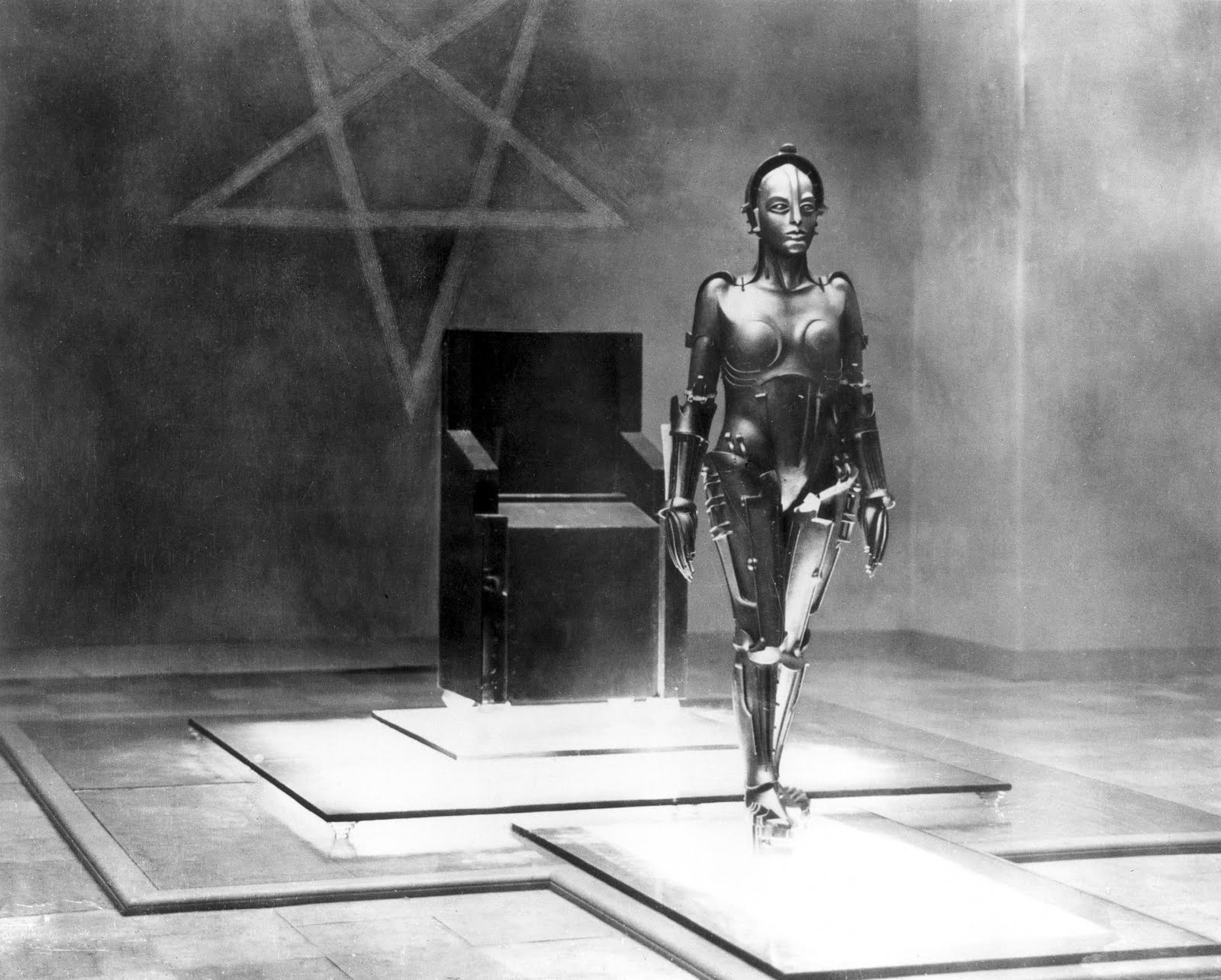
When his experts prove unable to explain the meaning of the papers, Fredersen seeks the counsel of the one man who he feels can provide the answer—the scientist Rotwang (Rudolf Klein-Rogge).  As young men, they had been close friends; however, that ended when Hel, the woman Rotwang loved, left him for the wealthy and powerful Fredersen.  She died giving birth to Joh Fredersen’s child, and Rotwang has hated Joh ever since.  He has constructed a “Machine-Man” (though in the shape of a woman) which he reveals to Fredersen, explaining that he intends to give it the appearance of his long-lost Hel.
The inventor recognizes the diagrams; they are in actuality maps of ancient catacombs that lie buried far beneath the city.  The pair journeys down into the underground passages, and find a large gathering of workers.  A young woman is addressing the gathering, recounting the biblical story of the Tower of Babel.  It is Maria, the same woman who so captivated Freder in the garden.  In her interpretation of the story, the moral is that between those who planned the great tower (the Head), and those who were tasked with building it (the Hands), there was no communication, no sense of common purpose.  They needed a “Mediator” between them, the Heart, which must join Head to Hands.
As Fredersen ponders the woman’s message, he fails to notice that, among the crowd of workers, is his own son.  He has traded places with a laborer in order to experience that life, while the workman, Georgy #11811, is enjoying himself with the diversions of wealth.  Rotwang however, recognizes his rival’s heir speaking with Maria after the ‘lesson’, but keeps that information to himself.
Fredersen asks the scientist to give the maschinenmensch (machine man) Maria’s image, in order to spread dissension between the workers and she.  Rotwang agrees to this plan, concealing his true intentions—to destroy the man who robbed him of his love.

Filmed over a period of eighteen months, from March 1925 to October 1926, METROPOLIS was the costliest silent production ever undertaken, at RM (Reichsmarks) 5,000,000 (nearly $15 million, in 2009 dollars).  Photographed by Karl Freund, Günther Rittau, and Walter Ruttman, with special effects by Eugen Schüfftan, it was also the most technically ambitious film of its era.  Produced by UFA, the leading German studio in the 1920’s, Lang’s masterpiece drove the company to the brink of bankruptcy.  It premiered in Berlin on 10 January 1927, at a running time of 153 minutes.

However, shortly after its Berlin premiere, the film was heavily edited, primarily at the behest of Paramount, the studio that would distribute the film in the United States, in order to make it more commercially marketable, as well as to eliminate certain scenes that would cause problems for American exhibitors.  Much of this editing was done by Channing Pollock, a noted American playwright.  The effect of these edits shortened the film considerably, as well as altered the storyline, eliminating some plot elements entirely.  The movie became less concerned with the class struggle between those who lived in the gleaming towers of the magnificent aboveground city and those workers who tended the machinery below.  The emphasis of the story shifted to the film’s Science-Fiction aspects.  The German negative was then edited to conform to the US cut, and the sections of film excised were destroyed.  For more than eighty years, the original version of METROPOLIS was lost.

However, in 2008 it was announced that a complete negative, including that material removed in the Pollock edit, had been found in a film archive in Buenos Aires, Argentina.  The original had been transferred to 16mm at some point, without the original negative having been cleaned and properly restored first.  The result was a negative cluttered by dust, scratches, and artifacts that are now part of the image.  Nonetheless, it was a complete negative, and using it, a restoration team headed by Martin Koerber was able to recreate the movie almost as it was at the January 1927 Berlin premiere.  In February 2010, the restored version had its premiere in Berlin, just over 83 years after it had first screened.  That version is now available from Kino International in a deluxe, two-disc DVD, The Complete METROPOLIS.

Priced at $20.97 direct from Kino ($18.99 from Amazon.com), this disc is comfortably within what I consider a reasonable price range, particularly for so important a film.  It adds roughly 25 minutes to the 119-minute runtime of the 2002 restoration, as well as filling in the plot holes which have existed since 1927.  Characters once thought to be at the most minor roles have been expanded into important figures in the story.  The effect is, if not a different film, then certainly one that must be viewed in a different light.

Included on the DVD’s second disc is a documentary on the history of the movie and it’s many changes through the years, Voyage to Metropolis.  This includes footage of interviews with Lang prior to his death, as well as with those who were instrumental in bringing this version to light.  The documentary is invaluable for fans of the movie.

It’s always tricky recommending that readers buy a silent film—not because of any flaws in the films themselves, but because modern viewers seem to have little patience for silents.  If you are someone who has this ingrained dislike for silent film, please try to overcome it here.  This is arguably the most historically significant Science-Fiction motion picture ever.  It deserves to be seen and appreciated, and the fact that it can now be seen as intended only reinforces that recommendation.

01 December, 2007

Silent Screams: Ten Silent Horrors Every Fan Should Own

Anyone who’s even a casual student of film knows that, from the earliest days of cinema until 1927, the movies were silent. There was usually a musical accompaniment, but the film itself did not carry a sound track. There was no dialogue, no sound effects. Thus, over thirty years worth of film history has been written off by fans who, for one reason or another, refuse to watch a silent film. That’s unfortunate, especially for fans of horror. Many of the most influential Horror and Science-Fiction films extant, films that continue to inspire filmmakers today, are silent, and should be seen by everyone who considers themselves Horror Fans.

Personally speaking, I’ve long had a love of silent film, ever since the day I watched a screening of F. W. Murnau’s 1922 classic NOSFERATU at a school Halloween carnival when I was a first-grader. There was absolutely no sound… no music, nothing save the click-clack of the projector and the quiet hum of it’s cooling fan—and the startled gasps of a tent full of children as Count Orlok climbed the staircase to the bedroom of Ellen Hutter.

That scene had a power to impress itself upon the consciousness that wasn’t dependent on dialogue or an evocative score; visual cues were all we had to go by, and our minds absorbed the play of every shadow on that staircase. That’s the beauty of silent film: It strips away the distractions, and leaves nothing but the visual medium on which to focus.

In little over thirty years of Silent Cinema, some of the greatest films in history were produced, many of these genre films. This is my list of ten of those films, ten that should be in every collection. Though subjective, I do believe that these are the “Essentials”, the ones that are too important to miss.

1.) NOSFERATU-EINE SYMPHONIE DES GRAUENS ~aka~ NOSFERATU-A SYMPHONY OF HORROR—F. W. Murnau—1922: Very nearly a “lost” film, as Bram Stoker’s widow sued successfully to have the film destroyed for infringing on the Dracula copyright, NOSFERATU stands as one of the most influential Horror Films ever made. Coming at the height of the German “Expressionistic” movement, Murnau’s skillful use of light and shadow, the stylized look of the sets, and the design of Max Schreck’s make-up, all serve to create an unforgettable visual narrative. Most of it works very well, even after 85 years. What doesn’t age as well are the stiff, wooden performances from most of the cast. Still, this is a true classic, one that never fails to reveal new facets of itself.

2.) DAS KABINETT DES DOKTOR CALIGARI ~aka~ THE CABINET OF DR. CALIGARI—Robert Wiene—1919: Perhaps the first true Horror Film, it single-handedly gave birth to the aforementioned “Expressionist” movement in German cinema, though how it came to pass was something of an ‘unintended consequence.’ Germany was plunged into economic devastation following its defeat in World War I; consequently, even the cost of lighting film productions was prohibitive. Robert Wiene, who was well known in art circles but had little experience in film, asked the leaders of a new school of art to design and create sets that would look good without the need for expensive lighting effects. The result was a visual style that would influence the next twenty years of Horror Films.

3.) THE PHANTOM OF THE OPERA—Rupert Julian—1925: The most important American Horror Film of the silent era, this is the film that made Universal a great studio, and cemented Lon Chaney, Sr.’s status as a great star. The sheer scale of the production was enormous, and marked a major commitment for Universal Studios. The Paris Opera House set still survives, at least as recently as 2001, and still sees occasional use.

4.) METROPOLIS—Fritz Lang—1927: One of the first Science-Fiction films, Lang’s social commentary is one of the most powerful films of the ‘20’s. Composed of striking visuals and a frenetic pace of action, this film established Lang as a master of the genre film.

5.) THE CAT AND THE CANARY—Paul Leni—1927: One of the first, and certainly the best, of the “old dark house” style of mystery thrillers, THE CAT AND THE CANARY originated as a stage play in 1922. When noted German filmmaker Paul Leni brought it to the screen for Universal, little did he know that he was drafting the blueprint for the great Universal Horrors of the 1930’s and ‘40’s. Leni, who would die of toxemia in 1929 at the age of forty-four, made skillful use of shadows, cobwebs, and secret passages, conventions that would become trademarks of movies such as DRACULA, FRANKENSTEIN, and THE BLACK CAT.

6.) THE UNKNOWN—Tod Browning—1927: Of the more than 100 films Lon Chaney made during his life, fewer than forty survive, and this is one of his best. Directed by Tod Browning, who had been raised in a circus and never lost his affinity for the bizarre and grotesque, this is Chaney’s crowning achievement in contortion. Playing Alonzo the Armless, Chaney learned to do everything, from throwing a knife to lighting a cigarette, with his feet. Alonzo is in love with Nanon, the circus-owner’s daughter. Nanon, played by Joan Crawford, has a deep psychological aversion to a man’s touch, thus making her the perfect object of Alonzo’s affections. What follows is a haunting psychological horror, laden with sexual overtones, as we see to just what depths a twisted man will sink for love.

7.) HÄXAN ~aka~ WITCHCRAFT THROUGH THE AGES—Benjamin Christensen—1920: Part documentary, part horror film, this Swedish import is one of the most visually unique of the first era of Horror. Rarely seen in it’s original form, due to the scenes of Satanic rituals and frequent nudity, it’s recently been released to DVD from The Criterion Collection, in its complete state.

8.) THE LOST WORLD—Harry Hoyt—1925: Though Willis O’Brien’s Dinosaur creations appear crude in comparison to the work he would do a short eight years later in KING KONG, they were head and shoulders above anything anyone else was doing at the time. The script, based on a story by Sherlock Holmes creator Sir Arthur Conan Doyle, is rambling and incoherent, and Hoyt might as well have telegraphed his direction in from home. Not that it mattered; this was Obie’s movie, and his monsters carried the day perfectly well.

9.) THE LODGER—Alfred Hitchcock—1926: Not Hitchcock’s first film, but certainly the first that foretold the brilliance of the man who would become the genre’s greatest director. Based loosely on the Jack the Ripper murders, this movie displays many of the hallmarks of Hitchcock’s latter films, and should be a must-see for fans of the director.

10.) DER GOLEM ~aka~ THE GOLEM—Paul Wegener—1920: Not the first film version Wegener directed of the Gustav Meyrink novel, but the only one that survives, a valid argument can be made that this film is the direct ancestor of James Whale’s FRANKENSTEIN; certainly more so than the 1910 Edison film. Visually impressive, it is one of the great masterpieces of the German cinema.

If you’re a fan of Silent Film, then these movies are probably familiar to you; at least, most will be. If not, then consider this list a jumping-off point for an exploration of early cinema. Silent movies have much that they can offer the viewer, and while it is a different experience, it is also one that is very rewarding. I think it would be unfortunate to miss out on that experience, just for the want of a soundtrack.


Posted by Picasa