Welcome to the Crypt!

Welcome to the Crypt!

Enter the Crypt as John "The Unimonster" Stevenson and his merry band of ghouls rants and raves about the current state of Horror, as well as reviews Movies, Books, DVD's and more, both old and new.

From the Desk of the Unimonster...

From the Desk of the Unimonster...

Welcome everyone to the Unimonster’s Crypt! Well, the winter’s chill has settled into the Crypt, and your friendly Unimonster won’t stop shivering until May! To take my mind off the cold, we’re going to take a trip into the future … the future of Star Trek! Star Trek was the Unimonster’s first love, and we’ll examine that in this week’s essay. We’ll also inaugurate a new continuing column for The Unimonster’s Crypt, one written by the Uni-Nephew himself! This week he examines one of his favorite films, one that, quite frankly, failed to impress his uncle, Jordan Peele’s Nope. So enjoy the reading and let us hear from you, live long and prosper, and … STAY SCARY!

Popular Posts

Followers

Essays from the Crypt

Essays from the Crypt
Buy the best of the Unimonster's Crypt

Search This Blog

13 June, 2011

Junkyardfilm.com's Moldy Oldie Movie of the Month: MOON OF THE WOLF

Title:  MOON OF THE WOLF

Year of Release—Film:  1972


Two stereotypical Southern rednecks wake up to the sounds of dogs howling from the swamp.  Hastily pulling on their boots and grabbing their scatterguns, they go stumbling into the darkness.  Suddenly, it’s daytime and they’ve discovered the savaged body of a young female, Ellie, apparently torn apart by a pack of wild dogs.  Sheriff Whitaker (David Janssen) is called out to investigate the death, followed shortly by Lawrence (Geoffrey Lewis), the victim’s dimwitted ex-boyfriend, who demands to know who the culprit was.  Hot on his heels is the grouchy town Doctor Druten (John Beradino) who insults the locals by saying “It’s not considered good medical practice to perform autopsies in the middle of swamps surrounded by howling dogs and scratching rustics.”  Back at the hospital, the doctor tells Sheriff Whitaker that she was killed by a single blow to the head from a left-handed person.

Later that afternoon, Sheriff Whitaker goes to visit Lawrence’s father, Old Man Hughes who, because he’s old and has lived all his life on Marsh Island, must know something about this...even though he’s frail, has dementia and is bedridden!  The Old Man keeps babbling on about something called a “lookaroo” but no one knows what he’s talking about.  Leaving the Old Man’s shack, Whitaker next goes to the mansion of the island founder’s offspring, Andrew Rodanthe (Bradford Dillman) and his sister, Louise (Barbara Rush).  (Janssen keeps pronouncing their last name as Rodan, which delighted me!)  Louise having just returned from living in New York City, is pleasantly surprised to find her old high school crush is now the town sheriff and begins outrageously flirting with him.  Sending Louise back into the mansion, Andrew curtly dismisses the sheriff, explaining that Louise is ill and needs rest and quiet.  Whitaker leaves and drives to the murder scene where he discovers a locket in the mud.  The two rednecks from the movie’s opening scene come strolling by so the Sheriff asks if the locket belonged to the murdered Ellie but they claim to never having seen it before.  Whitaker just shoves this potential clue into his pocket and leaves, leaving this viewer convinced the Sheriff just isn’t into this investigation!

Back in town, the Sheriff has a conversation with the Old Man’s caretaker who spills the beans that Ellie was pregnant!  Find out who the father was and you’d have your killer!  Naturally, Whitaker rushes back to the doctor’s office and demands to know why the doctor didn’t tell him of the girl’s pregnancy!  After some verbal sparring, the doctor confesses that he himself was the father.  “I didn’t kill her!  I loved her!” exclaims the doctor as Whitaker takes a long pull off the doctor’s whiskey bottle.  Now, apparently, everyone in town had a motive to kill her!  Later the same day, the town’s men-folk gather to go into the swamps and shoot the pack of wild dogs that killed Ellie.  Suddenly, Lawrence rushes out from the crowd and socks the doctor in the jaw, decking him, while shouting to everyone that the doctor knocked up the dead girl.  Arresting Lawrence, the Sheriff drives back to the Rodanthe place where he and Louise get to know each other better over glasses of lemonade.

Suddenly, it’s nighttime again and we watch as the Sheriff leaves Lawrence in the hands of his deputy, instructing the night-shift deputy to leave the cell door unlocked.  (Whitaker does run a tight ship, doesn’t he!?!)  Hearing a loud noise from the back of the station, the deputy decides not to follow the Sheriff’s instructions and locks Lawrence’s cell door before investigating the noise.  In a POV shot, we see the deputy torn apart before the POV beast tears the locked cell door off its hinges and savages Lawrence!  Dr. Druten tells Whitaker that the men have been torn apart by bare hands.

The next day, rich-kid Andrew volunteers to go with Whitaker to the Old Man’s place to help with the investigation.  But once there, Andrew suffers a fit when smelling some sulfur and molasses burning in a dish on the front porch.  This concoction is supposed to ward off ... werewolves!  PLOT POINT!  Whitaker drives to pick up Louise and take her to the hospital but sees a photo of Louise wearing the locket he’d discovered at the murder scene.  Louise admits it’s hers but she hadn’t seen it in years.  Back at the hospital, Andrew explains that he suffers from a rare malaria-like disease called Black Water Fever.  In order to keep his disease from becoming town gossip, Andrew had Ellie bring him a month’s supply of his medication from the hospital and he had given Ellie the locket earlier the evening she died.  Louise suggests that since she speaks French, she go talk to the Old Man. Listening to the Old Man babble, Louise says he’s not saying “lookaroo” but is actually saying “Loup-garou” which is French for ... WEREWOLF!  Suddenly, the Old Man grabs Louise’s hand and, speaking French, tells her she will be the next victim!  And, back in his hospital bed, we see the hairy, clawed hand of Andrew!

Andrew, now in full werewolf-mode, bursts from his hospital room, scares some nurses, knocks down an orderly and jumps through a plate-glass window, making good his escape.  A posse is formed to search the swamps for Andrew and Whitaker drives Louise back to the mansion.  But, Andrew isn’t in the swamps but has gone back home where Louise is reading up on lycanthropy and lycanthrope-like diseases.  Explaining to the sheriff that werewolves can only be killed by fire or by bullets that have been blessed, Whitaker decides to search for Andrew alone and he locks all the windows and tells Louise to lock the door after him.  But, Louise listens just about as well as the night-shift deputy did and leaves through a window when she hears werewolf-Andrew bust down the front door.  Running into the barn, she sees werewolf-Andrew standing in the loft and, flinging a burning oil lamp at him, rushes from the burning barn.  BUT WAIT!  Despite being burned to a cinder, werewolf-Andrew survives and, neatly pressed clothes uncharred, chases Louise up the stairs.  Bursting into her room, he’s met with a hail of bullets from Louise’s gun and collapses in the hallway as Whitaker arrives.  And, in true, time-honored, werewolf movie fashion, Andrew dies with his normal Andrew-face as Louise sobs “He knew!  He must have replaced my bullets with blessed bullets!”

Okay...in all fairness, for a made-for-TV movie, this wasn’t bad.  It wasn’t good either.  Barbara Rush played the sister with believability and Janssen, always looking like he’s suffering from some indigestion problems, was likeable as the Sheriff.  Because of some obscure pork-barrel politics, Bradford Dillman was required by Law to appear in every 70’s made-for-TV movie.  The sets appear to have been real Louisiana swamplands.  Beradino played the doctor in such a crotchety, unlikable way I’m surprised that any female, much less a lovely girl like Ellie, would have had anything to do with him.  The werewolf make-up was laughably BAD!  And the plot-holes...How was Andrew a werewolf?  Was he bitten by one before the movie began?  Or, as his sister explains, did he inherit the affliction from his Grandfather, who was given to “spells?”  And why did the Sheriff not bother to investigate any of the multitude of clues presented to him?  And, what about the super-human strength of the werewolf?  I don’t recall Lon Chaney, Jr., having the strength to rip through solid-steel cell bars!  And, someone should have told scriptwriter Alvin Sapinsley it’s SILVER BULLETS that kill werewolves, not blessed ones!  Still, for a 1970’s TV movie, it had a nice In the Heat of the Night atmosphere and nice little murder-mystery beginning, making for a nice little family-friendly werewolf movie.

Enjoy!  Or not!

MSTjunkie


Cambot's Voice by S. J. Martiene: EXPERIMENT 3: I WAS A TEENAGE WEREWOLF

Cambot’s Voice by S. J. Martiene

EXPERIMENT 3:  I WAS A TEENAGE WEREWOLF


I mentioned in Experiment 1 that I was a Mom of two teenagers. Some of the best, MSTied movies feature the teenager and B-movie genres.  It just so happens that this month’s feature, MST3K #809 I Was a Teenage Werewolf fits both bills perfectly. Of course, they are SUPPOSE to be teenagers in this film, but Hollywood has an affinity for older actors playing high-schoolers; ONE of which is playing our monster. We have it all in this movie.  There is milk-throwing, raw meat-eating, a Halloween party, bad singing, a mad scientist, and yes…a werewolf. The fact that THIS particular lycanthrope is portrayed by none other than TV icon, Michael Landon makes this movie interesting for riffing on so many fronts.  There are Bonanza jokes, Little House on the Prairie jokes, and Highway to Heaven jokes.  There is even one riff dedicated to a 1976 autobiographical movie Landon wrote and directed called The Loneliest Runner.
I have to say that since re-watching this movie, the host segments are some of the best of the series.  With a runtime of only 76 minutes, the host segments are a bit more detailed and really show the comedic timimg and writing talents of the gang.  So enjoy, as we take you through the exploits of 1957’s I Was a Teenage Werewolf.

Cast

Cast overview, first billed only:
Michael Landon
...
Yvonne Fedderson
...
Arlene Logan (as Yvonne Lime)
Whit Bissell
...
Tony Marshall
...
Dawn Richard
...
Barney Phillips
...
Detective Donovan
Ken Miller
...
Cynthia Chenault
...
Pearl (as Cindy Robbins)
Michael Rougas
...
Robert Griffin
...
Joseph Mell
...
Malcolm Atterbury
...
Eddie Marr
...
Vladimir Sokoloff
...
Louise Lewis
...
HOST SEGMENT 1:
The Bots want to overthrow Mike as Captain of the ship – they soon learn none of them are capable of replacing him.  Crow and Tom nominate Gypsy, but she has to run the ship.  Crow has a set of creepy crawlers in the thing-maker…and well, Servo…is Servo.  He has prepared a “statement” on WHY he cannot be Captain.  This is one of my favorites, so read on, won’t we?

“..I cannot be Captain, for you see dear friends, I am unfit to lead other men into battle, into space, or in a line dance.  I submit that if I picked my nose for a half an hour, my head would cave in.  I’m nary to know betwixt shinola and that other stuff.  I cannot lead because I cannot find my ass with both hands and a flashlight…I will now open the floor to questions about my accomplishments.”
Since Servo’s concession speech is over, Mike regains his position as Captain.  Servo mocks him as only a conceding Bot can.  Pearl, Brain Guy, and Professor Bobo are on Earth (somewhere).  They are camped out and Pearl has told Mike she is putting the crew on battery back-up, disconnecting them from their main power source.  This upsets Mike greatly..”We’ll be without power???”  And then, what follows, is the BEST Pearl Forrester line ever:

“….You know what else?  You’ll be without diapers too, you big, huge, giant babies!! DEAL WITH IT!!”
Pearl packs up all the gear, and sends the guys a movie.  Soon, there’s a hull breach and Servo comes back with a face hugger.
MOVIE SIGN!
During this film, there are many parodies of the Bonanza theme song.  The movie opens with our lycanthropic protagonist, Tony, in a school yard fight.  Soon we see Detective Donovan (Barney Phillips).  You may remember him from the EXCELLENT Twilight Zone episode, Will the Real Martian Please Stand Up?  He does what he can to calm Tony down, but he doesn’t want to have any of it.  You will notice a high number of Richard Jewell jokes during this segment.  Google him if you don’t remember what happened at the ’96 Olympics.  Anywho, Donovan wants Tony to see a “doctor/shrink/mad scientist”.  Tony disagrees and walks off with his girl.  The next scene takes us home and his Dad.  Tony protests too much when Dad tries to talk about his stubbornness.  His Dad leaves for work, chiding him to NOT eat his lambchops raw like he did his burgers.  Tony has had enough of everyone yapping at him all day and we see the whole premise of his demise see ….MILK HURDLING!! (all the guys make kitty meow sounds here) The scene switches to Arlene’s house, where “Jabba the Husband” and the woman with “Aaron Burr’s Hairstyle” live.  They give the 50’s “talking” to the Tony the boyfriend.  Girlfriend starts harping about the doctor again. 
Now it is PARTY TIME…with vague “Kinda White” music, innocuous pranks, great lines, and the running joke with safety dummy, Resusi Anne .  “Ah...kids those days!”  (Crow)
HOST SEGMENT 2
Crow has a Proximity Detector to see how bad the alien life forms are on the ship.  They are all OVER, problem is…..he had the wrong setting activated on the detector and was measuring the humidity.  They have LOTS of humidity, by the way.

MOVIE SIGN
Back to the party..”Elvis J. Pollard” is singing.  “We are now entering a genital-free zone.” (Servo) The song,  is one of the worst ever, almost as bad as when Michael Landon was on the TV show Hullaballoo (Google that if it is around…YIKES).  After the song is over, the DUMB pranks start.  Mike:  “The Carnival of Souls boyfriend.”  One of the guys blows a horn in Tony’s ear….and suddenly it’s “The Sock Hop of the Damned” (Mike).  Tony slugs one of his friends and pushes down his girlfriend.  Servo laments, “I thought it was alright if I picked a little fight, Bonanza?”
That little episode at the party lands our little werewolf-to-be in the office of veteran B-movie actor, Whit Bissell (who was actually in some really good films too).  Bissell’s character, Dr. Brandon also has a sidebar conscience (his assistant played by Joseph Mell).  Dr. Brandon hypnotizes him, and he closes the session saying, “Soon…you’ll be yourself.”  “An angel, a cowboy, a pioneer dad.” (Mike)
The kids have another gathering…but Tony is bumming.  Frank (another kid) isn’t pairing up with anyone and will walk home alone. 
Cut to Frank walking home ALONE. ”Ray Fiennes IS Li’l Abner!”  (Crow)  “I was a teenage werewolf snack.” (Servo)  We know Frank is TOAST he just runs and falls and falls and runs…and well…this IS a predictable set-up in a B-movie.

HOST SEGMENT 3
Servo hunts down face hugger and kills him. Did I mention he was heavily armed? He is going after the “beast” that has the ship surrounded.  Crow and Mike are taking bets on how long it takes Servo to cry.  And he does cry..singing…”Don’t Cry Out Loud”, “You’ll Never Walk Alone”, and “(They’re Coming to) America”.

MOVIE SIGN

The movie returns and we find ourselves at the police station, with Detective Donovan.  Another policeman walks in.  This guy….NAMED GUY Williams did not get a first billing, but he became known later playing TV’s Zorro and Dr. John Robinson of Lost in Space.  Also, there is an introduction to Pepe,the janitor, at the police station who wanted to look at the pictures.  Pepe knows right away, the death is caused by a werewolf.  “You’re crazier than Dr. Smith!” (Servo)

Tony goes back for another session at Dr. Brandon’s.  Tony is scared.  “I found a leather jacket in my stool this morning!” (Servo)  Brandon keeps battling with his assistant.  Tony remains tense.
High school, high school and we have to see a girl in yucky gym leotards.  Tony talks to the principal and he gets kudos from her.  He leaves and starts watching the gymnast. “It’s alright if I kill a couple of kids, Bonanza!” (Crow)  He leaves the office and bells ring “Oops, he’s Johnny Depping.” (Mike) He attacks her in front of many people then, the poor girl dies.  “This is good, she caught him in the act and she can rub his nose in it.” (Servo)  When the cops arrive, all the kids finger Tony, but they can’t believe it.  Even Dr. Brandon denies Tony could BE a werewolf.  Everyone gets a going over, the Dad, the girlfriend, and Tony is still howling up and down the woods.  “Just give him a Liv-a-snap.” (Servo) 

HOST SEGMENT 4

The beast is laying GIANT alien eggs. The guys start making omelettes and …well, Crow starts designing the menu.  “She’s not around, which means she could be anywhere!”  (Servo) Suddenly Crow becomes a restaurant critic.

MOVIE SIGN!
A search commences for Tony.  I’ll just list a series of riffs during this segment because there is no real action to describe except for guys peering through things.  “Try banging on his food dish, men.” (Mike)  “The Bernard Hermann score really heightens the tension”.  (Servo)  “Looks like Paddington on a bender”  (Mike)  “This werewolf is a herbivore.  Luckily, this guy’s name is Herb.”  (Crow)  “Indiana Jones and his sidekick, Merle.”  (Crow)  “Never let Jose Feliciano lead your search party.” (Mike)  “Sir, I think I saw a werewolf with a Chinese menu in his hand.” (Mike)  “1943- an Ewok makes it behind German lines” (Servo)
Finally Tony changes back to Tony.  He calls Arlene but cannot speak to her.  The police want to know who called her; she couldn’t tell.  “…I’ll check in with Huggy Bear.” (Servo) Tony then returns to Dr. Brandon, who decides to put him under one more time.  “Dogs can sense bad acting.” (Servo)  Tony changes back into a wolf; this isn’t good for Whit Bissell.  The cops FINALLY come in and look at the debris field.  “Wow, a werewolf that size can really poop!”  (Servo)  They shoot to kill, guessing somewhere along the line the silver bullet necessity has been covered.  Tony is dead.  Whit Bissell is dead.  All that is left is for the police to cry over spilled werewolf.
The guys exit the theater and they soon see the alien has taken over the ship.  They have to reverse the ship polarities to remove it.  This didn’t work, so they have to do the one thing they were saving that would repulse the alien so much, it would have to leave.  Mike became Adam Duritz of Counting Crows.  It worked.  Once they regained control of the ship, we see Pearl telling ghost stories around the campfire to Bobo and Brain Guy.  She has them crying like little girls.
This movie is a howling good time.  Seriously, it has EVERYTHING.  I have seen it unriffed and riffed many, many times and every time I laugh my butt off.  If you get the chance to see it, don’t miss it. 
These following websites are invaluable for information.  Check them out, won’t we?


Creighton’s Creature: THE WOLF-MAN and Lon Jr.

  
Following the departure of the Laemmles from Universal Studios in the mid-1930’s, Standard Capital, which was headed by J. Cheever Cowdin and was the studio’s new owners, made a conscious decision to avoid Horror films, hoping to become known for a more “upscale” product.  They failed, as would a so-far unbroken line of their successors, to give the studio’s iconic Monsters the respect they were due, and fans of the Monsters credit for knowing what they wanted.

By 1939 however, the studio was dealing with both a lack of mainstream success and a hurting bottom line.  The continued popularity of both DRACULA and FRANKENSTEIN in Los Angeles-area theaters convinced the studio that maybe Horror Films weren’t such bad ideas after all, and before the year was out, SON OF FRANKENSTEIN, starring Karloff, Lugosi, Rathbone, and Atwill marked the return of Horror to Universal.  That, and the debut in 1940 of the studio’s other great cash cow, the comedy duo of Abbott & Costello, insured that the Monsters would find gainful employment for some time to come.

But they needed fresh material to work with, not just sequels to existing properties.  They needed a new Monster.  And a script by Curt Siodmak gave them a great one:  Larry Talbot, aka—the Wolf-Man.
The first article to carry the Unimonster’s byline said this about Siodmak’s creation, “One of Universal’s most popular movies, THE WOLF-MAN came on the scene just as the second half of Horror’s Golden Age was beginning to take off.  The war in Europe, increasing economic prosperity, and changing tastes were going to put the monsters out of business, according to the critics.  Instead, they were entering the period of their greatest popularity, due primarily to Universal’s first truly sympathetic monster [Larry Talbot].  [C]ursed by the bite of a werewolf to an eternal, nightmarish existence, more beast than man … it provided a fresh perspective on the monsters; one from the monster’s point of view” [The Universal Monsters:  How Universal Studios Created the Horror Film, 6 February, 2010].  The werewolf make-up would be designed and executed by Jack P. Pierce, Universal Studios master craftsman of Monster-Making, based upon designs he created for 1935’s THE WEREWOLF OF LONDON.  And to play Talbot, the studio cast the son of the first icon of the Horror Film—Lon Chaney, Jr.

Born Creighton Chaney in 1906, the younger man was estranged from his father and raised by his mother, whom Lon had abandoned.  Creighton had no intention of following in his father’s Horror footsteps; indeed, his breakthrough came in the role of Lenny in Lewis Milestone’s 1939 version of John Steinbeck’s OF MICE AND MEN, for which he won critical acclaim.  However, pressure from studio executives meant an end to his dreams of a straight dramatic career, and to his public identity as separate from his father.  He had occasionally been billed as “Lon Chaney, Jr.” since 1935, and in 1940, Creighton appeared in ONE MILLION, B.C. under that name.  Creighton Chaney, at least as far as the movie-going public was concerned, ceased to exist.

Though in retrospect this outright manipulation of an actor’s career may seem callous and overbearing, in the context of the times it was accepted practice for studios to make decisions such as this.  The Hollywood “Studio System” completely dominated the film industry—it was the closest thing this country’s ever had to a tyrannical despotism—and if you desired to work in Hollywood, then you paid obeisance to the system.  The studio had a legitimate need, and no one felt any qualms about using Creighton to fill that need.
For along with Universal’s requirement for fresh material with which to work, they also needed a new star, a Horror icon to replace both Karloff and Lugosi, who had faded to supporting roles.  Who better to fill the void than the son of the “Man of a Thousand Faces?”

Lon Jr.’s Horror debut came on 28 March 1941, in MAN-MADE MONSTER, a B-grade programmer, directed by George Waggner.  Co-starring Lionel Atwill, Anne Nagel, and Samuel B. Hinds, the plot concerned a sideshow performer (Chaney, Jr.) with an unusual immunity to electrical shocks.  He agrees to be studied by a pair of scientists:  One benevolent, played by Hinds, and one evil, played to perfection by Atwill.  Unbeknownst to everyone, Atwill begins treating “Dynamo” Dan with increasingly powerful electrical impulses, transforming him into a mindless automaton with a deadly touch.  The movie was well-received, if a little ahead of it’s time.  A mere decade-and-a-half later, it would have fit perfectly on a Drive-In Double-bill with THE INCREDIBLE SHRINKING MAN or MONSTER ON THE CAMPUS.  In fact, it probably did, as it was reissued in 1953 under the title THE ATOMIC MONSTER.

Later that same year would come the film that would strengthen Lon Jr.’s status as a Horror star, and it, like MAN-MADE MONSTER, was to be directed by Waggner.  THE WOLF-MAN, released five days after the Japanese attack on Pearl Harbor, would become one of Universal’s most beloved Monster movies, and one of it’s most successful.

Scripted by Siodmak, and starring Claude Rains, Ralph Bellamy, Bela Lugosi, Evelyn Ankers, and Maria Ouspenskaya, THE WOLF-MAN gave Universal its first truly original monster, and the star that would carry Universal’s Monster franchise through to it’s end.  From 1941 to 1945, Lon Jr. appeared in all of Universal’s first-class Horror Films, and a large number of their second-class Horrors, such as the series of Inner Sanctum pictures that began in 1943.  He would play every one of Universal’s “Fab Four” of Monsterdom—Frankenstein’s Monster, in GHOST OF FRANKENSTEIN; Dracula, in SON OF DRACULA; the Mummy Kharis, beginning with THE MUMMY’S TOMB; and of course Larry Talbot, the Wolf-Man.

After the success of THE WOLF-MAN, Universal wanted a sequel, and a chance remark by Siodmak, intended as a joke, became 1943’s FRANKENSTEIN MEETS THE WOLF-MAN.  The studio had found the formula for Horror success in the ‘40’s—Multiple Monsters, formulaic plots, a beautiful girl or two to menace, some knock-down, drag-out Monster fighting, and a happy ending.  A simple prescription, true—but it kept theaters packed.

Lon Jr. would play Talbot three more times:  1944’s HOUSE OF FRANKENSTEIN, 1945’s HOUSE OF DRACULA, and the 1948 pairing of the Monsters with Universal’s other moneymaking property of the ‘40’s, Abbott & Costello, in ABBOTT & COSTELLO MEET FRANKENSTEIN.  That film would mark the beginning of the end of the Classic Monsters of Universal, relegated to the status of comedic props.  It would also mark the end of Lon Jr.’s association with the studio that had made him an icon, and which he, in turn, carried on his furry shoulders throughout the war years.

The end of the war meant the return of millions of GI’s to the Home Front, as well as revelation of the true suffering visited upon the tens of millions of victims of totalitarianism and fascism throughout Europe, Asia, and the Pacific Rim.  True horrors, revealed and remembered, left little room in the minds of moviegoers for the Monsters of fantasy and fiction.  Universal Studios, ten years removed from the days when Carl Laemmle, Sr. ran the show as a ‘family’ business, where the head of the make-up department could be hired on a handshake, fired Lon Jr. in 1948.  Nor did they stop there.  Jack Pierce, the same make-up artist who had created the image of every one of the studio’s iconic Monsters, from Dracula, to Frankenstein’s Monster, to the Mummy, to the Wolf-Man, the head of the make-up department who had been hired on the basis of a handshake, without a contract, was just as unceremoniously canned.

Recently however, the titular descendants of the men who so callously sacked Lon Jr., Jack, and others found a renewed attraction in the Monsters of Universal; an interest that had never waned among their devoted fans.  Beginning with 1999’s THE MUMMY, directed by Stephen Sommers, Universal has resurrected most of the studio’s great Monsters of the ‘30’s and ‘40’s.  So far, there’s been little interest in revisiting the Invisible Man, first realized by James Whale and Claude Rains in the 1933 classic.  And plans for a remake of the studio’s greatest Horror Film of the 1950’s, CREATURE FROM THE BLACK LAGOON, have been up in the air for years now.

But this month will see the return of Larry Talbot to theaters nationwide, as Universal unveils THE WOLFMAN, directed by Joe Johnston and starring Benicio Del Toro as Talbot, Anthony Hopkins as his father, Sir John Talbot, and Emily Blunt as Gwen Conliffe.  A big budget reimagining of the original story, the trailers promise a movie that looks beautifully filmed and exquisitely designed, with the requisite amount of dazzlingly spectacular special effects.  It remains to be seen whether or not it has managed to capture the spirit, the essence of what made the original film one of Universal’s most loved Monster movies.  One thing it has most certainly done is render invalid one of Lon Jr.’s proudest claims.  As he once told an interviewer, he had played all the Monsters—from Dracula to the Mummy.  But he—Creighton Tull Chaney—was the only actor to ever play the Wolf-Man.  No longer is that true.

Lon Jr. would continue to play monsters, maniacs, and murderers for another 25 years, until his death in 1973.  He would play many memorable characters in his later years, most notably Bruno the caretaker, from Jack Hill’s SPIDER BABY or, THE MADDEST STORY EVER TOLD.  But he was destined to be forever defined by his greatest role—that of a Welshman cursed to become a snarling, murderous beast, driven to bloodlust by the brightness of an autumn moon.


DVD Review: AN AMERICAN WEREWOLF IN LONDON—Two-Disc “Full Moon” Edition

Title:  AN AMERICAN WEREWOLF IN LONDON—Two-Disc “Full Moon” Edition

Year of Release—Film:  1981

Year of Release—DVD:  2009

DVD Label:  Universal Studios Home Entertainment


One of the most popular Horror Films of the early ‘80’s, and one of the greatest Werewolf films ever made, John Landis’ AN AMERICAN WEREWOLF IN LONDON redefined that genre of horror as thoroughly as Romero’s NIGHT OF THE LIVING DEAD did Zombie movies.  With Academy Award-winning Make-up effects by Rick Baker, a terrific script from Landis, and a trio of incredible performances from David Naughton, Griffin Dunne, and Jenny Agutter, AN AMERICAN WEREWOLF… stands head and furry shoulders above it’s lycanthropic competition of 1981, Joe Dante’s THE HOWLING and Michael Wadleigh’s WOLFEN.

Now Universal Studios Home Entertainment is releasing a brand-new two-disc “Full Moon” edition of this horror classic, hitting the stores this Tuesday, 15 September.  In addition to a spectacular assortment of special features is a new, feature-length documentary, written and directed by Paul Davis, entitled Beware the Moon.
Two American youths, David Kessler (Naughton), and Jack Goodman (Dunne) are backpacking through England, and stop at a pub in the village of East Proctor, a pub with the ominous name “The Slaughtered Lamb.”  Though the villagers are distant and cool towards the pair, the boys get along ok, until Jack asks the locals why they have a pentagram—a five-pointed star that legend holds is the mark of the werewolf—inscribed on the wall.

The innocent inquiry gets the pair banished from the pub, and they resume their hike with warnings to “… beware the moon …” and “… keep off the moors …” both of which are quickly ignored.  They soon find themselves lost, and being stalked by… something.  The pair is attacked; Jack dies, and just before David loses consciousness, the townsfolk of East Proctor, who followed the boys from the pub, shoot and kill their attacker.

Weeks later, David awakes in a London hospital to discover that his best friend is dead; officially, the two were attacked by an escaped lunatic.  However, that doesn’t fit with David’s recollection of events.  He saw the—thing—that attacked them, and it wasn’t human.  Something that his friend Jack—his dead friend Jack—soon confirms, when he pays David a visit in his hospital room.  They were attacked by a werewolf, and Jack is now condemned to exist as one of the undead until the werewolf’s bloodline is extinguished.  A bloodline that now continues in David.

With this movie Landis, who had made his reputation as a director of comedies such as ANIMAL HOUSE, THE KENTUCKY FRIED MOVIE, and THE BLUES BROTHERS, demonstrated that he was equally adept at Horror Films.  He skillfully blended both genres into a seamless whole, where the horror of David’s realization that he is a werewolf, and has viciously killed six people, can happen as he sits chatting with the corpses of his best friend and his victims in a pornographic theater.  The bizarre dichotomy of the situation is perfectly balanced, and the viewer is never made to wonder whether they are watching a funny horror, or a scary comedy.  It is what it is, and that is a terrific movie.

New to this release is Beware the Moon, a feature-length documentary by Paul Davis.  Exhaustively examining the history and lore of the film, Davis visits many of the locations used in the production, as well as interviewing virtually every major figure involved in bringing the movie to the screen.  Though most of the film’s background is well known to it’s fans, it has never before been presented in such depth and detail.  If this is an example of Davis’ work, then I have a list of a good dozen films I’d love for him to examine in the same manner.

This is without a doubt one of my favorite films, and one of the three greatest Werewolf movies ever produced (along with 1941’s THE WOLF-MAN and 2002’s DOG SOLDIERS).  Of course, the previous DVD release of this film resides in the Crypt’s library, but that doesn’t mean I’m not thrilled to have this release.  For those who love this movie, the Beware the Moon feature alone is worth the purchase price; for those who have yet to experience this classic, I cannot think of a better way to do so.


08 May, 2011

Before Skull Island: The Early Horror Films of Fay Wray


The image is iconic, and the sound is unforgettable: the director, hand-cranking the old motion-picture camera, urging his young starlet to “… scream, Ann … scream for your life!”  That scream, and the actress who produced it, would become part of Horror Film history.  The movie, of course, was 1933’s KING KONG, and the actress was a 26-year old Canadian beauty named Fay Wray.

Born Vina Fay Wray in Cardston, Alberta, Canada, Wray came to Hollywood as a teen-ager, getting bit parts and supporting roles in a variety of pictures.  Her major break came in 1928, in Erich Von Stroheim’s THE WEDDING MARCH.  Her first genre role came in 1932, and her last in 1935, but in those three short years she became the first true Horror queen.  The amazing part of her story is that she owes that status almost entirely to five films released in 1932 and ‘33:  DOCTOR X; THE MOST DANGEROUS GAME; THE VAMPIRE BAT; THE MYSTERY OF THE WAX MUSEUM; and, naturally, KING KONG.

Volumes have been written about KING KONG, analyzing every characteristic of the film, from the technical aspects of Willis O’Brien’s stop-motion animation to the psychosexual subtext of the plot.  Tens, perhaps hundreds, of thousands of words have been devoted to Wray’s performance in that film, and I’ll pass on adding to that total in this article.  I want to examine those four films that preceded KONG, the four little known gems in the crown of Horror’s first Queen.


DOCTOR X—(1932)

Starring Lionel Atwill, Preston Foster, and Wray, and directed by Michael Curtiz, Warner’s DOCTOR X is a very good little film about a cannibalistic “Moon-Killer,” who strikes under the full moon.  Filmed in Two-Strip Technicolor, an early color film process, the restored film has an odd, greenish cast to it that is strangely effective for the subject.  Curtiz, who would later direct what some feel to be the greatest film ever, 1943’s CASABLANCA, kept this film moving at a good pace overall, though there are points where the comedy relief wears thin.  Wray portrays Joan Xavier, the daughter of the titular Dr. Xavier, who is played wonderfully by Lionel Atwill.  As lovely as ever, she plays the role a bit too broadly, and for some reason seems as jittery as the proverbial long-tailed cat.  Still, it’s always easy to enjoy Wray on-screen, and this film is no different.
The true star of this movie, however, is Lionel Atwill, and he shows that he can chew scenery with the best of them.  The best scene in the film involves Joan reenacting one of the murders, playing the role of the young victim.  Her father and those suspected of being the “moon-killer” are strapped into chairs, watching what they believe to be a reenactment of the latest killing, as devices record their reactions.  However, the real killer has taken the place of the reenactor, and to their horror they realize Joan is being murdered in front of them, as they sit helpless.  Curtiz does a masterful job building the suspense as the scene unfolds, especially since the audience is aware that the real murderer is now involved.

As previously mentioned, the de rigueur comic relief wears on the viewer after a comparatively short period, particularly as the actor in question, Lee Tracy as a stereotypical big-city reporter, is also the romantic lead.  While a more competent actor might have pulled the combination off, Tracy fails abysmally in both facets of his role.

Yes, the performances are generally weak and the material is dated, but the overall effect of the film holds up well nonetheless, thanks in large part to the strong showing by Atwill.  One of the more underappreciated Icons of Horror, Atwill’s career as a star may have been short-lived, but his impact on generations of horror fans hasn’t been, and in recent years he’s been getting some of the recognition that’s due him.  DOCTOR X may not be his best work—that must undoubtedly be his performance as Inspector Krogh in SON OF FRANKENSTEIN… but it’s not far from it.


THE MOST DANGEROUS GAME—(1932)

As Merian Cooper and Ernest Shoedsack were putting Robert Armstrong and Fay Wray through their paces by day for KING KONG, Shoedsack and co-director Irving Pichel were working them just as hard at night to produce THE MOST DANGEROUS GAME.  With a script based upon a prize-winning story by Richard Connell, Shoedsack and Pichel constructed a first-rate thriller/adventure yarn, one that has been remade at least three times, and spoofed countless others.

The story centers on Count Zaroff, played by Leslie Banks, a wealthy recluse whose one passion is hunting.  He lives alone on a private island, save for his servants and his pack of hounds… massive, savage brutes, bred to the hunt.  Into this isolated locale comes the lone survivor of a shipwreck:  Rainsford, (Joel McCrea) a fellow hunter and adventurer.  He finds two castaways from a previous shipwreck, Martin Trowbridge, (Robert Armstrong) a dissolute playboy, given to drinking large quantities of the Count’s liquor; and Eve, Martin’s sister, played by Wray.

Though Zaroff seems the perfect host at first, his sinister persona soon manifests itself, and his true intention for his “guests” is revealed.  Zaroff, jaded with hunting even the most ferocious of beasts, indulges his desire for the ultimate challenge, the ultimate hunt—man.

He attempts to draw his fellow adventurer into sharing his hunts, but when Rainsford refuses, he becomes the quarry in a vicious fight for survival:  Elude the Count, and live until dawn—and win his freedom and that of Eve.  Fail and the Count will celebrate his triumph… with the unfortunate girl as his trophy.

Wray actually has a rather small part in this film, as the conflict between Rainsford and Zaroff is the engine that drives the plot.  The desire of both men for Eve is secondary to their true motivation—to kill the other.  Both are archetypal Alpha males, and the viewer soon realizes that, even absent Zaroff’s psychotic tendencies, conflict between the two would’ve been inevitable.  McCrea does a credible job as Rainsford, but Banks is simply the wrong choice as the uber-hunter Zaroff; in fact, the part would have been perfect for Robert Armstrong.  Banks is too soft, too cultured… too effete.  The supporting cast, including Armstrong, is superfluous; on-screen for far too brief a time to exert much influence over the flow of the film.  The focus is kept on the three main characters, and they drive it along nicely without them.

While not really a Horror Film, THE MOST DANGEROUS GAME certainly contains enough horrific elements to qualify it for this discussion, as does the film’s inherent quality.  What’s more, its impact on popular culture far outstrips its notoriety, as many people have seen spoofs of it without realizing what film was being riffed.  From Gilligan’s Island to Star Trek, this film has provided inspiration and material to television writers for decades—it’s time more people became familiar with the source of that inspiration.


THE VAMPIRE BAT—(1933)

This, the least well known of the four films in this retrospective, once again paired Atwill and Wray, he as the demented scientist, and she as his unwitting assistant.  The movie also features Melvyn Douglas as a police detective investigating a series of reputed “vampire” murders in a small central European village, and Dwight Frye as Herman, the ‘village idiot’ suspected of the killings.

The film opens as the town burghers are gathered in a closed session to discuss a rash of deaths that has recently plagued the German village of Kleinschloss, deaths that have coincided with a sudden infestation of large bats.  Also present is Karl Brettschneider (Douglas), the town’s chief law enforcement officer.  The odd manner of the deaths is the topic of the discussion—all the victims were found drained of blood, with two puncture wounds in their jugular veins.  The superstitious townsfolk are all too eager to seize on vampires as the cause of the deaths, citing records of similar deaths in the 17th Century.  Karl’s not convinced, believing there must be a human agent behind these murders.  He insists on conducting a proper investigation, not presiding over a modern witch-hunt.

He leaves them to their superstitions, heading to the home of Dr. Otto von Niemann (Atwill), the physician of Kleinschloss.  Karl is involved with the Doctor’s assistant, Ruth Bertin (Wray), a lovely, bright young woman, who resides at the Doctor’s manor house with her hypochondriac aunt, Gussie Schnappmann (Maude Eburn, as the comic relief) and von Niemann’s servants, Emil and Georgiana.  The Doctor has examined each of the victims, and can find no clue as to the identity of the culprit.  At that moment he is at the home of a survivor of a bat attack, Martha Mueller.  As he tries to calm her nerves, her friend Herman (Frye) tries to reassure the Doctor that the bats are harmless; he’s befriended them, and they wouldn’t hurt anyone.

The townsfolk are far less sanguine about the bats, and frankly speaking, about Herman.  Kringen (George E. Stone), the night watchman for the town, reports that Herman wanders the streets at all hours, playing with and talking to the hordes of bats that infest the town.  He raises the suspicion that Herman is the vampire, feasting on the blood of his fellows, though the Doctor advises him to watch that kind of talk, else he start a panic.  That admonition is soon forgotten, however, as the nervous townspeople watch Herman take a bat from a lamppost and tuck it gently into his coat pocket.

Dr. von Niemann returns home, where he finds the detective waiting to discuss the case with him.  The Doctor begs off, stating that he has important work to do, and dismisses the young people to less serious pursuits.  In the town square, the clock tolls midnight.  The window in Frau Mueller’s sick room opens slowly; the woman opens her eyes and screams.  The scene cuts to her lifeless corpse, lying in the morgue as the coroner enters the record of her death.  The cause—the bite of a vampire.

As the burghers gather over Martha’s body to discuss the latest murder, Herman quietly slips into the morgue, and seeing his friend’s body, runs out screaming.  To both Karl and the Doctor, this is plainly evidence that the man lacks the capacity to be the fiend for which they are searching.  The villagers however see it differently.  Kringen convinces them that Herman is the vampire, and that he himself is likely to be the next victim, as he’s trying to warn people about Herman.

The next morning, Ruth is eating breakfast in the garden, as Herman, concealed behind the wall, watches her.  Karl surprises her; he’s there to discuss the murders with von Niemann, but seizes the chance to get some time alone with Ruth.  The opportunity is soon lost however, as Aunt Gussie appears, in the throes of a hypochondriacal crisis.  She has discovered that she is experiencing, “… palpitations of the auricular, ventricular, mitral and tricuspid valves,”—in other words, her heart is beating.  The couple reassures her that she will be fine, then go to find the Doctor.

As they leave, Herman sneaks into the garden, distracting the woman so that he might take some of the food.  She catches him, however, startling him so that he accidentally cuts his finger.  Concerned of course about the possibility of a tetanus infection, Gussie rushes to fetch dressings for the man’s wound.

Inside, von Niemann has been searching his library for information on the lore of vampirism.  He’s reading from an old French text on the subject as Gussie enters.  She ridicules the legends they are discussing while waiting for Emil to bring the first-aid supplies.  As she waits, men from the village enter with news.  Kringen is dead, just as he feared—and Herman is nowhere to be found.  Not even Karl can deny the appearance of guilt this creates, and gives orders that Herman be apprehended—without harm.  The townspeople want to deal with him as one must with a vampire, but Karl forbids it.  Herman will be tried in a court of law, and the law will decide his fate.  But is Herman guilty of the crimes?  Is he in fact a Vampire, an undead creature of the night?  Or is there another answer for the mystery that’s plaguing the peaceful village?

Produced quickly by Majestic Pictures in order to capitalize on the forthcoming MYSTERY OF THE WAX MUSEUM, THE VAMPIRE BAT was filmed at Universal, on sets left over from both FRANKENSTEIN and THE OLD DARK HOUSE.  This was common practice for the “Poverty Row” producers, those low-budget studios that frequently lacked the assets of the major companies.   Often, the smaller of these were without even the rudimentary facilities for motion-picture production.  Renting soundstages, sets, even costumes at a major studio was far more cost-effective in the short term.  One thing that Majestic didn’t scrimp on was the cast.

Led by Lionel Atwill, one of the most underrated stars of the Golden Age of Horror, this was a group that one would’ve expected to see in one of the great Universal Horrors.  With co-stars such as Melvyn Douglas (who had just previously starred in James Whale’s THE OLD DARK HOUSE alongside Boris Karloff and Gloria Stewart), Dwight Frye (veteran of most of the Universal Horrors of the 1930s), and Wray, and filming on Russell Gausman’s spectacular sets, this movie looked far better than it had any right to look.

Directed by Frank R. Strayer, from a script by Edward T. Lowe, Jr., the story may be underwhelming at times; however, the high-quality cast performs superbly with little help from either screenwriter or director.  Strayer, forty-one years old when he directed THE VAMPIRE BAT, had been a director for only seven years and had thirty features to his credit prior to this film—not unusual for those filmmakers who earned their living on Poverty Row.  Best remembered for directing twelve entries in the popular “Blondie” series of movies (based on the venerable comic strip), Strayer had a twenty-five year long, very productive career.  Workmanlike and competent, if not gifted with an abundance of artistic talent, Strayer, and hundreds like him, were the unknown heroes of Hollywood.  They might not have gotten critical acclaim and name recognition, but they earned a living doing what they loved while entertaining millions.
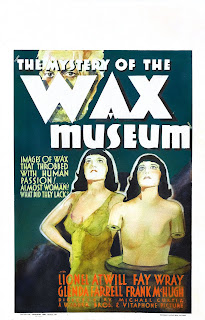


THE MYSTERY OF THE WAX MUSEUM—(1933)

The best of Wray’s Pre-KONG horrors, this was another of Warner’s experimental forays into color films, one that produced much better results than DOCTOR X did the previous year.  Not only was the color photography much improved, but the script, the acting, the direction—all was superior to the earlier film.

For the second time Wray is cast opposite Atwill, though her role is actually a minor one.  Atwill plays Ivan Igor, the curator of a wax museum, crippled years before in a fire his business partner started to collect on the insurance.  As the story shifts from London in the early ‘20’s to New York City’s New Year’s 1933 celebration, morgue attendants are loading a young woman’s body into a waiting hearse.  The body is that of Joan Gale, a woman believed to have committed suicide.  Florence Dempsey (Glenda Farrell), a newspaper reporter for the Express, is allowed to be present for the autopsy of the woman.  Earlier however, a vague figure, wearing a black cloak and hat, stole the body of Joan Gale, lowering it out the window to a waiting truck.  When the morgue attendants are sent to bring in the body of the suicide, they find it’s gone, and havoc ensues.

Police believe the body’s disappearance from the morgue is an effort to conceal evidence of murder, despite the earlier finding of suicide, and suspicion turns to a man named Winton (Gavin Gordon), the son of a wealthy industrialist and former lover of the dead woman.  Florence however, after interviewing Winton in jail, believes otherwise.  The next morning, she accompanies her roommate to her fiancé’s place of business.  Her roommate, Charlotte Duncan, (Wray) is engaged to Igor’s assistant, Ralph (a forgettable Allen Vincent).  Igor, now confined to a wheelchair, has other hangers-on about the place, ne’er-do-wells such as Darcy (Arthur Edmund Carewe), a seedy looking, self-styled “Professor” and drug addict, and a deaf-mute named Hugo (Matthew Betz).

Florence discovers a wax effigy of St. Joan of Arc that bears a striking resemblance to the missing dead woman, and becomes suspicious of the museum.  At the paper’s offices, she examines photos of the Gale woman.  She is convinced that the figure of Joan of Arc is the image of the dead woman, and that the body’s disappearance, perhaps even the woman’s death, is connected to Igor's waxworks.

Florence’s investigation of the waxworks leads her to follow Darcy to Winton’s liquor supplier, a bootlegger named Worth (Edwin Maxwell), who is the man who started the fire that injured Igor twelve years before.  She breaks into the warehouse where Worth stores his illegal liquor, discovering a hideous creature, face twisted and deformed.  It is the same monster who stole the body of Gale from the morgue.  When Darcy is arrested leaving the place, all the police can find are bootleg bottles of whiskey.  However, while searching the man, by now beginning to suffer through withdrawals, a watch belonging to a Judge Ramsey, who disappeared months earlier, is found.  Detectives begin a rigorous interrogation of the junkie, who finally cracks under the strain.  Yes, he killed Judge Ramsey—who died because he resembled Voltaire.  That’s the secret of Igor’s amazingly life-like effigies.  They look so realistic because there’s a dead body concealed in each one.  Joan of Arc wasn’t merely modeled after a dead woman; the woman herself is sealed within the waxen shell.  In addition to supplying victims to Igor, he was tasked to keeping a close tab on Worth while working with him, to aid Igor in exacting his ultimate vengeance against the man who crippled him.

During the interrogation of Darcy, Florence, accompanied by Winton, goes back to the wax museum to search for clues.  Prior to their arrival, however, Charlotte shows up, looking for Ralph.  Igor, obsessed by her resemblance to his lost ‘masterpiece’, his sculpture of Marie Antoinette, tricks her into his basement ‘workshop’, then stands up to reveal that he’s not as infirm as he wants people to believe.  He grabs Charlotte, telling her she will have eternal beauty as his Marie Antoinette.  She struggles against him, striking his face.  In the film’s most iconic scene, it shatters, breaking apart like the wax mask it was, revealing the twisted face of the creature from the warehouse.  Charlotte screams, then passes out.

Florence, Ralph, and Winton, now together in the museum, hear the screams and head downstairs.  After breaking into the concealed workshop, Ralph fights Igor, but is knocked unconscious.  Florence and Winton look on in horror, unsure of how to help Charlotte, herself unconscious and strapped to an operating table, as a vat of boiling wax begins filling a sprinkling system suspended over her.  As they stare at the scene unfolding below them, the police, in response to Darcy’s confession, burst in.  They are forced to shoot Igor, who falls into the massive vat of wax.  Ralph comes to, pulling Charlotte out of harm’s way just as the molten wax starts to rain down.

Florence has her story, and apparently, her man.  Winton has fallen madly in love with her, proposing to her in the midst of their adventure.  She starts to tell her editor, when he also asks her to marry him.  With a quick glance out the window at Winton cooling his heels in his expensive car, she tells her editor yes, and the film ends on a happy note.

Warner Bros. in the 1930s was known for it’s gritty, realistic crime dramas, not Horror films.  However, even by those standards this is an atypical picture.  It is definitely a pre-code film, meaning it was produced before the strict guidelines of the Motion Picture Production Code came into use in 1934.  Had this movie been produced as little as one year later, it would have been a far different film.  Not only would the mention of Winton and Gale having lived together have been banned, but also would the device of Darcy being a junkie, and the background that Joan Gale had been a narcotics user.  A humorous scene between Florence and a cop at the station, in which she snatches a racy magazine out of his hands, while inquiring about his, “… sex life,” would certainly be out, as would other questionable remarks by Farrell’s character.  One need only compare this film to it’s 1953 remake, the Andre de Toth-directed HOUSE OF WAX, to get a sense of what a post-code version would have resembled.  It is fortunate for fans of this film that it was produced in 1933, not 1934, as the 1933 film is far superior to the remake, in large part due to the increased realism and maturity of the material.

Though Wray’s role in this production is minor, it is the one that stands out as the most memorable.  She, after all, is the object of the villain’s obsession, and the image of the beauty that he longs to recreate.  And to her is given the honor of unmasking the evil within Igor, both figuratively and literally, in the film’s spectacular dénouement.

Long thought to be a ‘lost’ film, a complete print was fortunately found in the private archive of Jack Warner, and restored to its full glory in the 1980s.  MYSTERY OF THE WAX MUSEUM remains a glittering diadem from Horror’s Golden Age.

Every era of Horror has had its female icons—more popularly known as “Scream Queens,” whether they were virginal victims or vengeful vixens.  In the ‘40s it was Evelyn Ankers and Simone Simon; in the ‘80s, Sigourney Weaver and Jamie Lee Curtis.  But through all the decades, one name, and one beauty, has reigned over them all—so much so that now, nearly eighty years since her famous scream first thrilled moviegoers she is still a household name.  The role of Ann Darrow may have been the sparkling diamond in Fay Wray’s career—but it was far from the only jewel in the crown of Horror’s first Queen.